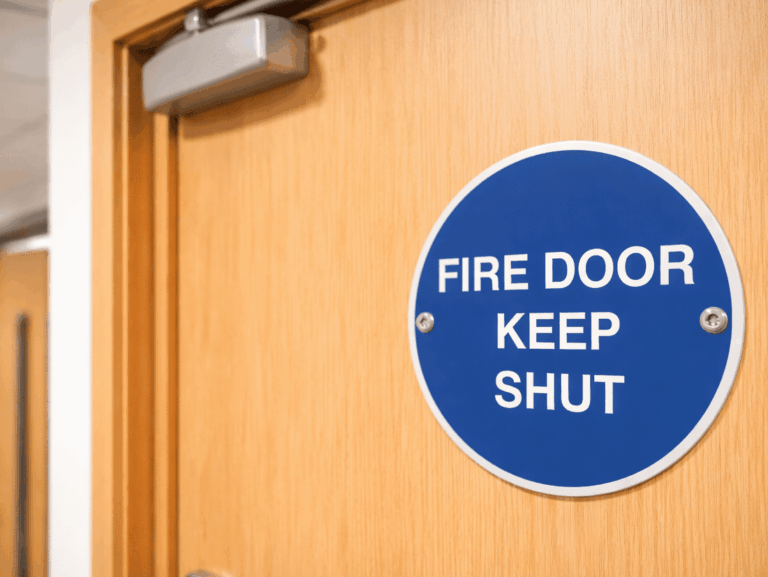

A report into fire doors in social housing has found significant shortfalls in inspection rates.
Sentry Fire Safety Group used Freedom of Information requests to local authorities in England gather data on the inspection of entrance doors and communal fire doors.
Fire Safety (England) Regulations 2022 implementation questioned
The report, A Burning Issue: The Reality of Fire Door Safety in Social Housing, found shortcomings in the implementation of the Fire Safety (England) Regulations 2022.
According to the report, 46% of flat entrance doors and 89% of communal fire doors have been inspected at least once since January 2023.
However, the research shows a significant number of doors do not meet the FD30 standard, the minimum requirement for 30-minute fire resistance under Building Regulations.
The findings from the report show that 63% of entrance doors and 67% of communal doors inspected did not meet this threshold.
Additionally, 63% of non-compliant doors remain awaiting repair or replacement, while 51% of responding local authorities do not currently have a formal remediation plan in place.
Industry leaders call for stronger action on fire door compliance
Jon Gatfield, Executive Chair of Sentry Fire Safety Group, said: “It has been three years since the Fire Safety (England) Regulations came into force and our research shows that implementation has not progressed at the pace required to protect residents.
“Without intervention, non-compliance will persist. We are not here to apportion blame.
“Our goal in publishing this research is simple: to support measurable risk reduction, drive stronger accountability and strengthen protection for residents.
“We believe there’s a need for a co-ordinated and cross-sector response to ensure safety obligations are delivered in practice, not just in principle.”
Bob Blackman MP, chair of the All-Party Parliamentary Group on Fire Safety and Rescue, said: “Fire safety failures are preventable. We must address the structural weaknesses, from funding to greater transparency, before further risk accumulates so that we can ensure every resident is protected by standards that are actually enforced.
“Addressing these issues is critical to safeguarding vulnerable tenants and ensuring that homes are genuinely safe from fire.
“With collective action, we have a chance to turn regulation into reality.”