
Health and wellbeing is naturally high on the agenda in healthcare facilities, but what more can be done to ensure fire door safety is being met with competency and not complacency? Alex Airnes of Allegion UK discusses.
Healthcare environments are synonymous with caution, wellness and safety. Though, where National Health Service professionals work determinedly to meet the needs of their patients, equally as vital are the fire door safety procedures practiced throughout NHS premises.
Fire safety management plays a crucial role in all healthcare settings, where protecting staff, visitors and potentially vulnerable patients is a continuous effort. Even with a host of unique operational challenges, hospitals, for example, are often considered to be one of the safest public buildings. In fact, a survey conducted by The British Woodworking Federation discovered that 52% of respondents believed hospitals to provide the highest level of fire safety in a building.
Despite these perceptions, NHS data has previously reported a concerning rise in fire incidents across sites around the country. The inherently busy nature of healthcare settings and around-the-clock use of facilities containing vulnerable patients, medical equipment and even flammable materials, presents a complex set of fire safety issues that must be addressed. With that in mind, is there perhaps more work to be done to ensure fire door safety is approached professionally to further mitigate risk?
Health and fire door safety
In the three months ending January 2025, an average of 46,000 people visited major hospital A&E departments each day in England, with a further 27,300 visitors attending minor A&E facilities every day. Fire doors play a vital role in protecting each of those individuals, but when paired with the fast-flowing traffic often found in healthcare facilities, this sustained level of footfall can create relentless environments that are unforgiving on fire doors and their hardware.
As a critical element of passive fire protection, fire doors are designed to compartmentalise fire and smoke for a specified period of time. Where fire could spread quickly across the interconnected sections of healthcare estates, fire doors will form protective barriers for a minimum of 30 minutes (FD30) or 60 minutes (FD60), allowing occupants to escape and preventing potentially life threatening smoke inhalation in the process. Fire doors can only operate effectively when working in tandem with their hardware components, such as hinges, seals and fire door closers. Yet, all too often in healthcare settings, fire doors and their hardware become damaged and fall victim to improper maintenance and use, with some self-closing doors even propped open to improve the flow of traffic and ease of access for beds, wheelchairs and medical trolleys. In turn, this leaves closers disengaged and renders doorsets useless in the event of a fire.
Under the Regulatory Reform (Fire Safety) Order 2005, healthcare management teams are given a direct responsibility to ensure employees and patients are safe within their premises. With this, NHS trusts must nominate a ‘responsible person’, which is often an individual who possesses a legal responsibility to demonstrate effective fire safety procedures, undertake risk assessments and meet fire safety compliance. In demanding healthcare environments, regular fire door inspections are key, and as part of their duties, a designated responsible person must have a firm understanding of fire door checks and maintenance, whilst also raising staff awareness on the importance of fire door safety. For this, ongoing education is key.
Prevent and protect
In order to retain the integrity of a fire door and its components, healthcare estates must consider how accurate specification, professional installation and ongoing maintenance can help to reduce common hazards and the possibility of danger before it surfaces.
Routine fire door checks can save lives and should form the agenda of anyone responsible for fire safety management. They consist of reviewing the specification, installation, condition and certification of:
- The door furniture
- The hinges
- Locks and latches
- Door closers
- Hold open devices
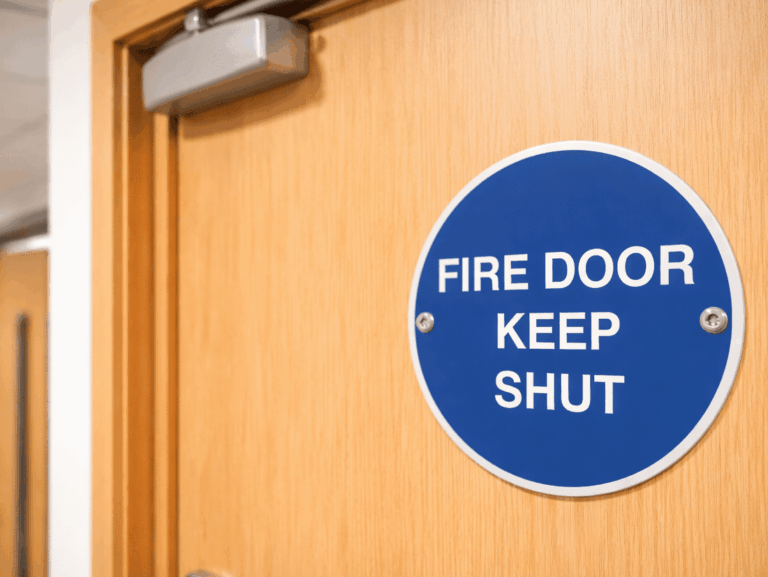
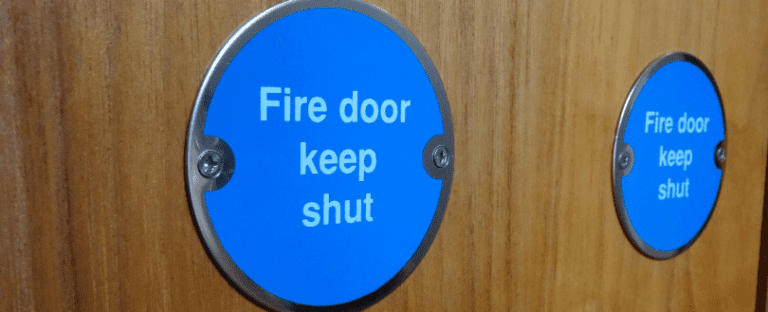
- Signage
- Exit devices
- Door seals
- The gaps around the door (3mm is recommended for fire doors)
When performing a closing action, a fire door calls upon each of these components and as such, not one element can fail in the event of a fire. To meet the necessary standards, the complete fire doorset must pass a series of standardised tests in the form of UKCA and CE certifications, which healthcare officials can identify – alongside a fire door’s FD ratings – by reviewing the label, usually found on the top edge of the door.
Correct specification is essential to long-term performance too. For high-use areas in large hospitals, for example, electromagnetic hold-open devices are a more appropriate choice and allow fire doors to close once a fire alarm is activated, automatically releasing the door in a safe and controlled manner. In smaller, slower-paced settings, cam-action closers with slide arms can fulfil fire door regulations whilst providing ease of operation and accessibility for vulnerable users who may otherwise struggle with heavy doors.
Regardless of size, layout and the building’s needs, all healthcare facilities must look to inherit a regular maintenance plan for their fire doors and emergency exit routes. In doing so, teams can highlight any early signs that a fire door is not performing as it’s required to, which can help prevent irreparable damage to the door and its hardware – saving the need for replacements and reducing costs for establishments managing budget restraints. When a fire door and its hardware is no longer compliant, teams must ensure repairs and replacements are made quickly and at a professional standard.
Fire door safety is an ongoing responsibility for healthcare management teams and requires comprehensive planning and regular action. Where patient safety remains the primary focus, a proactive approach is necessary. As such, healthcare officials are urged to pay close attention to their estate’s fire door safety measures, because although fire is unpredictable, it is in most cases preventable.