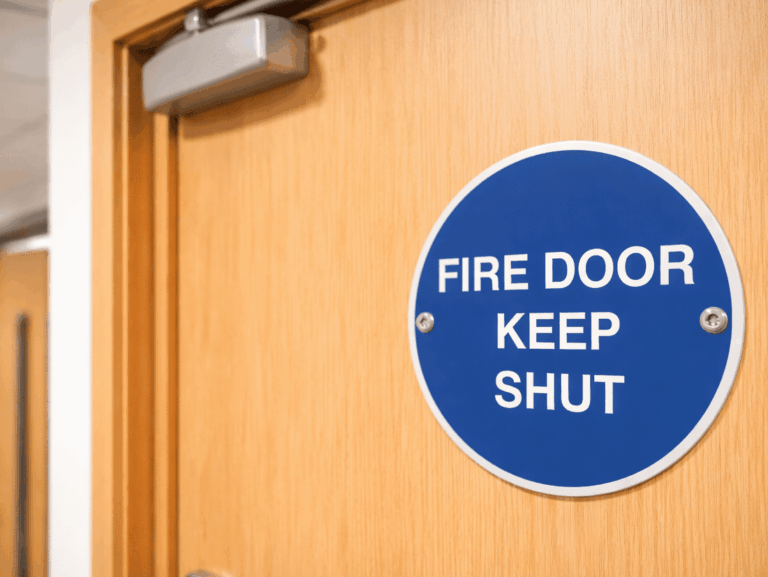

Fire-door compliance has moved from parts to full systems. Modern estates need certified doors, hardware and documentation proving integrity throughout. Joseph Clarke writes.
In a built-environment where fire safety regulation is evolving rapidly, asset owners and duty-holders face a dual challenge: upgrading hardware and doors while maintaining a coherent audit trail.
The transition from legacy specifications to the wider adoption of EN 1634-1 (and related test standards) demands a holistic approach. It is no longer enough simply to replace a leaf: the door, frame, seals, hardware and hold-open or self-closing mechanisms must form a tested, certified system.
Regulation Trends
Until recently, many fire-doors in the UK were specified under BS 476 or relied on legacy test regimes. Those remain relevant, but the industry’s move is unmistakably towards European-derived standards such as EN 1634-1 for fire resisting doorsets, and EN 1634-3 for smoke control. For facility managers, this means they must not only specify door leaves, frames and hardware that carry appropriate test evidence, but must treat the door assembly as a system. The door leaf alone is insufficient. Documentation, installation, certification and maintenance must align. Failure to do so leaves a compliance gap, and remaining risk.
In this landscape, modernising estates requires a roadmap: assess what is in place, identify zones of risk (residential flats, communal cores, plant or industrial, large-aperture logistics) and apply solutions tailored to each.
Hold-Open and Retention
Fire doors often need to be held open for access or ventilation, but that must not compromise their closing ability in an alarm event. Fireco’s Dorgard Pro system is a radio-activated fire-door retainer. It holds fire doors open legally and safely and critically releases them when the alarm calls. Such systems enable estate managers to balance access and ventilation with fire-safety integrity. In an upgrade programme one of the first tasks is to review all doors with hold-odevices. For example, are they a compliant retainer such as Dorgard Pro, wired into the alarm panel? The ability to monitor and record systems is increasingly expected. Without this, even a well-tested door leaf can be compromised by non-closing hardware.
Hardware Integrity
Once the hold-open is sorted, the next major element is door hardware: closers, latches, exit devices, hinges and associated ironmongery. Allegion UK (via its Briton brand) has published a ‘Fire Door Hardware Fundamentals’ guide aimed at responsible persons navigating the regulatory changes. The guide emphasises correct specification, installation and maintenance of hardware compatible with fire-door assemblies. Speaking on the launch of the guide last year, Pete Hancox, Country Manager at Allegion UK, commented: “At Allegion we believe it’s more important than ever before to understand essential procedures, standards and set guidelines, and in launching our latest Briton fundamentals guide, we’re aiming to bridge the gap between awareness and expertise by providing an invaluable resource to our customers.”
TO READ THE FULL ARTICLE SEE OUR LATEST ISSUE HERE: