Staging Site!

Who’s Who – 3FFF Limited

3FFF Limited, a market leader for fluorine free foams and fire suppression technologies discusses innovation for a safer, greener world. Contact information: Unit B, 18 Brunel Road, Earlstree Industrial Estate, Corby, Northants, NN17 4JW, UK +44 (0) 1536 202919 sales@3fff.co.uk 3fff.co.uk In the critical realm of fire suppression, a quiet revolution is underway, driven by companies like 3FFF Limited. Gone are the days when effective firefighting came at the expense of environmental damage. Today, 3FFF Limited stands at the forefront, developing and manufacturing next-generation foam concentrates that champion both unparalleled performance and unwavering environmental responsibility. The Dawn of Clean Fire Suppression Headquartered in Corby, Northamptonshire, England. 3FFF Limited has rapidly emerged as a leading innovator in the clean fire suppression movement. Our mission extends beyond simply extinguishing fire; it’s about safeguarding lives, protecting valuable assets, and preserving our environment for future generations. This holistic approach resonates deeply in an era where environmental stewardship is paramount. The challenge is clear: For more than seven decades, traditional firefighting foams, while effective, often contained PFAS (Per- and Polyfluoroalkyl Substances), namely PFOS, PFOA, with long-term environmental and health risks. 15 years ago, 3FFF Limited rose to this challenge, bringing together a team with decades of industry knowledge and an insatiable drive for innovation. The result? A pioneering portfolio of Smartfoam firefighting foam solutions that redefine safety without compromise. Technology that promotes sustainability At the heart of 3FFF Limited’s success lies its commitment to groundbreaking technology: PFAS-Free Foams: This is more than just a product line; it’s a commitment. 3F has engineered high-performance, fluorine-free alternatives that effectively eliminate the environmental risks associated with older legacy foams, setting a new industry benchmark for responsible fire suppression. Solvent-Free Formulations: Unique 3F technology. Prioritising the well-being of both responders and ecosystems, our solvent-free formulations deliver robust and reliable results in the most critical fire scenarios, ensuring safer operations for emergency personnel. Sector-Specific Solutions: Recognising that fire hazards vary widely, 3F offers formulated products tailored to the unique demands of diverse sectors. From the stringent requirements of aviation and defence to the complexities of oil & gas, marine environments, and municipal firefighting. Our solutions are precisely engineered for optimal effectiveness, including specialised foams for fixed suppression systems, ensuring comprehensive protection. Relentless Research & Development: Innovation is the lifeblood of 3F. Through continuous in-house research and development, we remain agile to meet the evolving global regulations and to deliver optimal, field-proven performance in real-world emergencies. A Commitment Etched in Every Drop 3FFF Limited ‘s ethos is simple yet powerful: fire protection should never come at the expense of environmental integrity. This commitment is embedded in every product we develop, ensuring that our range of Smartfoam foam concentrates are: • Biodegradable • Non-persistent • Globally Compliant and Field-Proven. As industries globally seek cleaner, safer solutions, 3F is not just a manufacturer and supplier of firefighting chemicals; it’s a partner with a vision for sustainable firefighting. 3F are actively shaping a future where advanced fire protection including high performance and environmental responsibility can, and must, coexist.

Who’s Who – 3FFF Limited Read More »
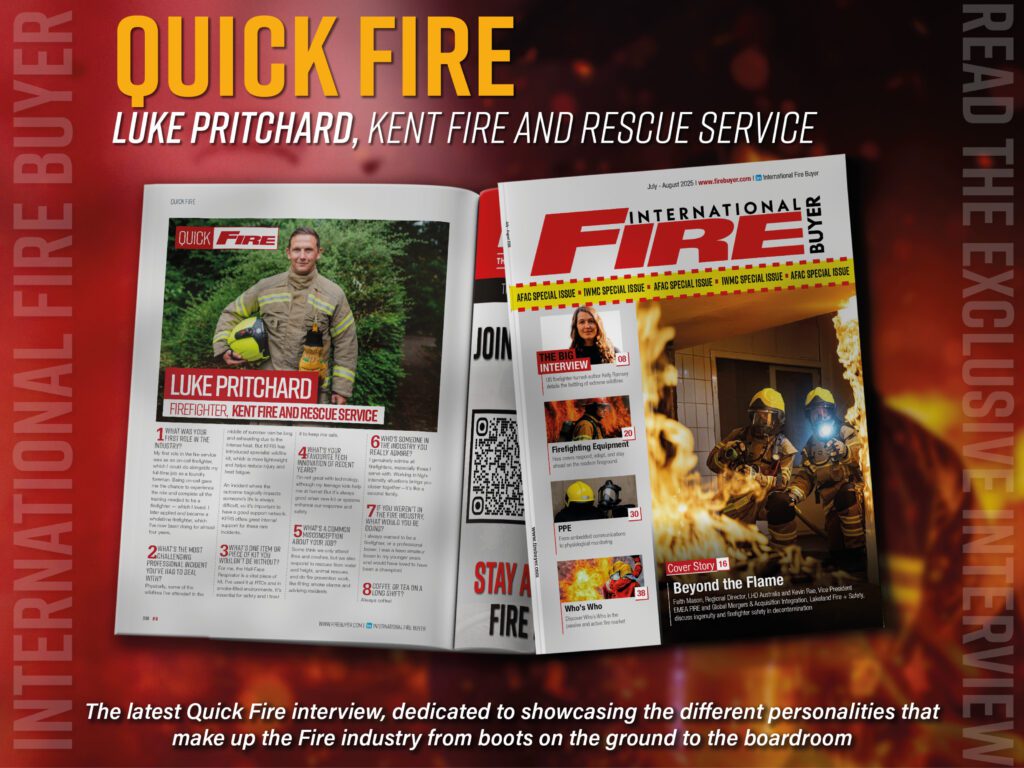
Quick Fire – Luke Pritchard, Firefighter

What was your first role in the industry? My first role in the fire service was as an on-call firefighter, which I could do alongside my full-time job as a foundry foreman. Being on-call gave me the chance to experience the role and complete all the training needed to be a firefighter — which I loved. I later applied and became a wholetime firefighter, which I’ve now been doing for almost four years. What’s the most challenging professional incident you’ve had to deal with? Physically, some of the wildfires I’ve attended in the middle of summer can be long and exhausting due to the intense heat. But KFRS has introduced specialist wildfire kit, which is more lightweight and helps reduce injury and heat fatigue. An incident where the outcome tragically impacts someone’s life is always difficult, so it’s important to have a good support network. KFRS offers great internal support for these rare incidents. What’s one item or piece of kit you wouldn’t be without? For me, the Half-Face Respirator is a vital piece of kit. I’ve used it at RTCs and in smoke-filled environments. It’s essential for safety and I trust it to keep me safe. What’s your favourite tech innovation of recent years? I’m not great with technology, although my teenage kids help me at home! But it’s always good when new kit or systems enhance our response and safety. What’s a common misconception about your job? Some think we only attend fires and crashes, but we also respond to rescues from water and height, animal rescues, and do fire prevention work, like fitting smoke alarms and advising residents Who’s someone in the industry you really admire? I genuinely admire all firefighters, especially those I serve with. Working in high-intensity situations brings you closer together – it’s like a second family. To read the full article see our latest issue here.

Quick Fire – Luke Pritchard, Firefighter Read More »

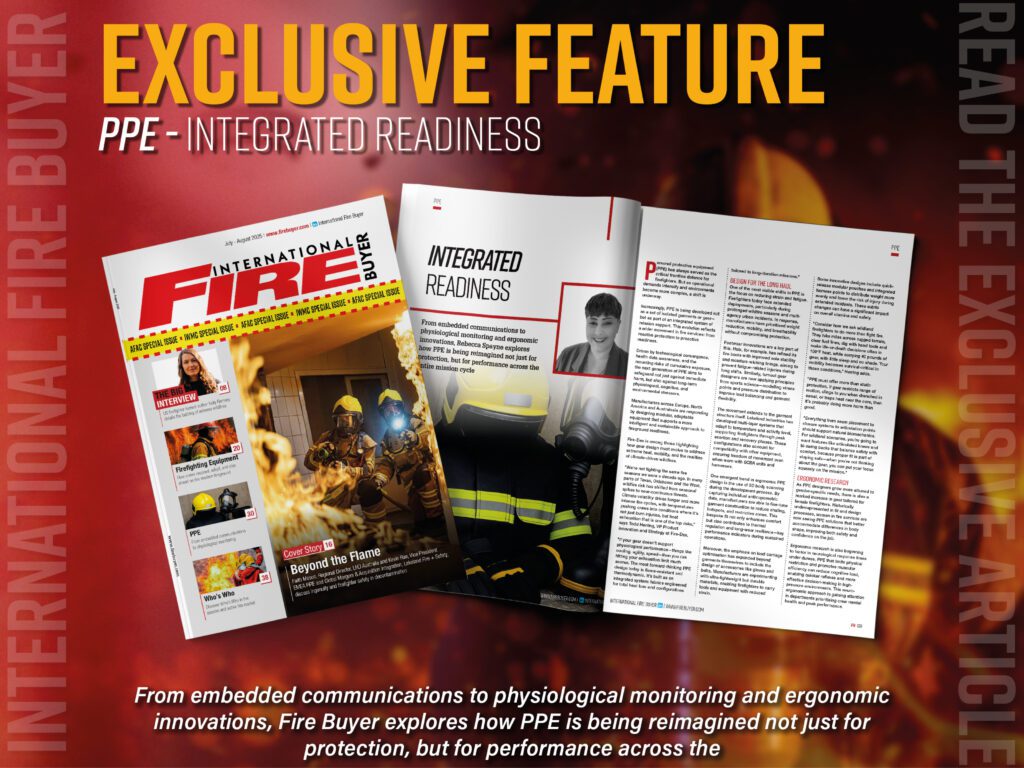
PPE – Integrated Readiness

From embedded communications to physiological monitoring and ergonomic innovations, Rebecca Spayne explores how PPE is being reimagined not just for protection, but for performance across the entire mission cycle. Personal protective equipment (PPE) has always served as the critical frontline defence for firefighters. But as operational demands intensify and environments become more complex, a shift is underway. Increasingly, PPE is being developed not as a set of isolated garments or gear—but as part of an integrated system of mission support. This evolution reflects a wider movement in fire services: from reactive protection to proactive readiness. Driven by technological convergence, health data awareness, and the mounting risks of cumulative exposure, the next generation of PPE aims to safeguard not just against immediate harm, but also against long-term physiological, cognitive, and environmental stressors. Manufacturers across Europe, North America and Australasia are responding by designing modular, adaptable equipment that supports a more intelligent and sustainable approach to fireground readiness. Fire-Dex is among those highlighting how gear design must evolve to address extreme heat, mobility, and the realities of climate-driven wildfires. “We’re not fighting the same fire seasons we were a decade ago. In many parts of Texas, Oklahoma and the West, wildfire risk has shifted from seasonal spikes to near-continuous threats. Climate volatility drives longer and more intense fire cycles, with temperatures pushing crews into conditions where it’s not just burn injuries, but heat exhaustion that is one of the top risks,” says Todd Herring, VP Product Innovation and Strategy at Fire-Dex. “If your gear doesn’t support physiological performance—things like cooling, agility, speed—then you risk hitting your exhaustion limit much sooner. The most forward-thinking PPE design today is flame-resistant and thermodynamic. It’s built as an integrated system: fabrics engineered for total heat loss and configurations tailored to long-duration missions.” One of the most visible shifts in PPE is the focus on reducing strain and fatigue. Firefighters today face extended deployments, particularly during prolonged wildfire seasons and multi-agency urban incidents. In response, manufacturers have prioritised weight reduction, mobility, and breathability without compromising protection. Footwear innovations are a key part of this. Haix, for example, has refined its fire boots with improved sole stability and moisture-wicking linings, aiming to prevent fatigue-related injuries during long shifts. Similarly, turnout gear designers are now applying principles from sports science—modelling stress points and pressure distribution to improve load balancing and garment flexibility. The movement extends to the garment structure itself. Lakeland Industries has developed multi-layer systems that adapt to temperature and activity level, supporting firefighters through peak exertion and recovery phases. These configurations also account for compatibility with other equipment, ensuring freedom of movement even when worn with SCBA units and harnesses. One emergent trend in ergonomic PPE design is the use of 3D body scanning during the development process. By capturing individual anthropometric data, manufacturers are able to fine-tune garment construction to reduce chafing, hotspots, and restrictive zones. This bespoke fit not only enhances comfort but also contributes to thermal regulation and long-wear resilience—key performance indicators during sustained operations. To read the full article see our latest issue here.

PPE – Integrated Readiness Read More »

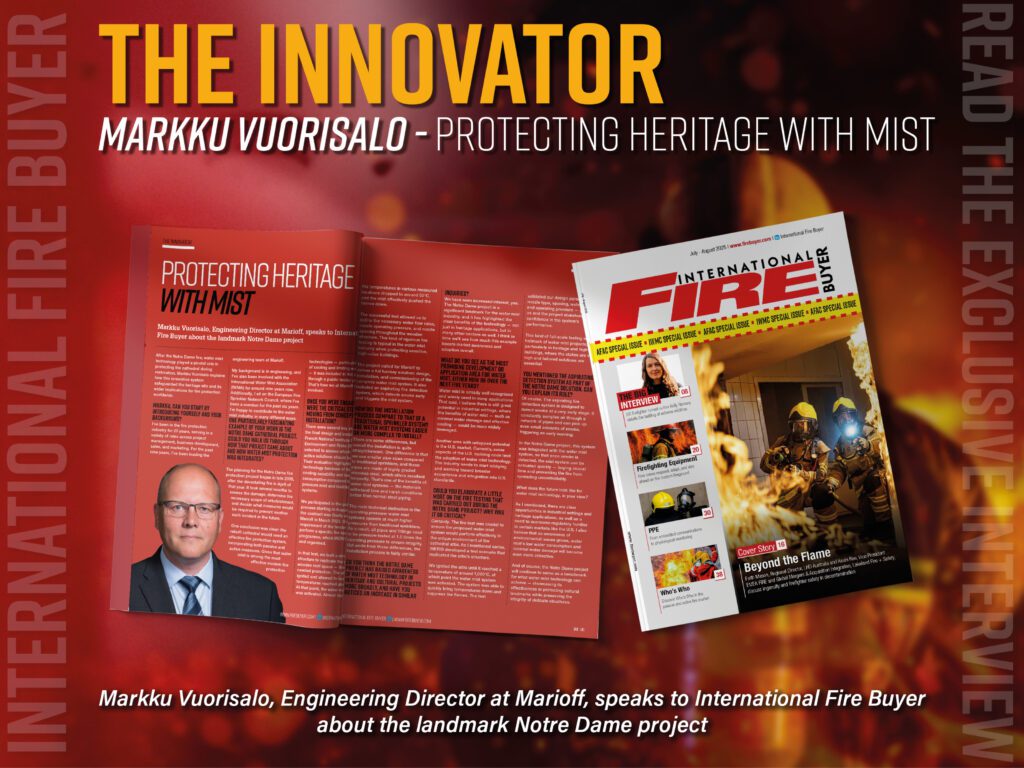
Innovator – Marioff

Markku Vuorisalo, Engineering Director at Marioff, speaks to International Fire Buyer about the landmark Notre Dame project. After the Notre Dame fire, water mist technology played a pivotal role in protecting the cathedral during restoration. Markku Vuorisalo explains how this innovative system safeguarded the heritage site and its wider implications for fire protection worldwide. Markku, can you start by introducing yourself and your background? I’ve been in the fire protection industry for 25 years, serving in a variety of roles across project management, business development, sales, and marketing. For the past nine years, I’ve been leading the engineering team at Marioff. My background is in engineering, and I’ve also been involved with the International Water Mist Association (IWMA) for around nine years now. Additionally, I sit on the European Fire Sprinkler Network Council, where I’ve been a member for the past six years. I’m happy to contribute to the water mist industry in many different ways. One particularly fascinating example of your work is the Notre Dame Cathedral project. Could you walk us through how that project came about and how water mist protection was integrated? The planning for the Notre Dame fire protection project began in late 2019, after the devastating fire in April of that year. It took several months to assess the damage, determine the necessary scope of refurbishment, and decide what measures would be required to prevent another such incident in the future. One conclusion was clear: the rebuilt cathedral would need an effective fire protection system, incorporating both passive and active measures. Given that water mist is among the most effective modern fire protection technologies — particularly in terms of cooling and limiting water damage — it was included in the project through a public tender process. That’s how we at Marioff became involved. Once you were engaged, what were the critical steps in moving from concept to actual installation? There were several key steps before the final design and installation. The French National Institute for Industrial Environment and Risks (INERIS) was selected to assess which passive and active solutions should be considered. Their evaluation highlighted water mist technology because of its superior cooling capability and low water consumption compared to low-pressure mist and traditional sprinkler systems. We participated in the public tender process starting in August 2022, and the contract was finally awarded to Marioff in March 2023. One important requirement of the tender was to perform a specific fire test programme, which INERIS planned and organised. In that test, we built a simulated attic structure to replicate the cathedral’s wooden roof space — the area that needed protection. The attic was ignited and allowed to burn until temperatures reached about 1,000°C. At that point, the water mist system was activated. Almost immediately, the temperatures in various measured locations dropped to around 50°C, and the mist effectively pushed the flames down. To read the full article see our latest issue here.

Innovator – Marioff Read More »

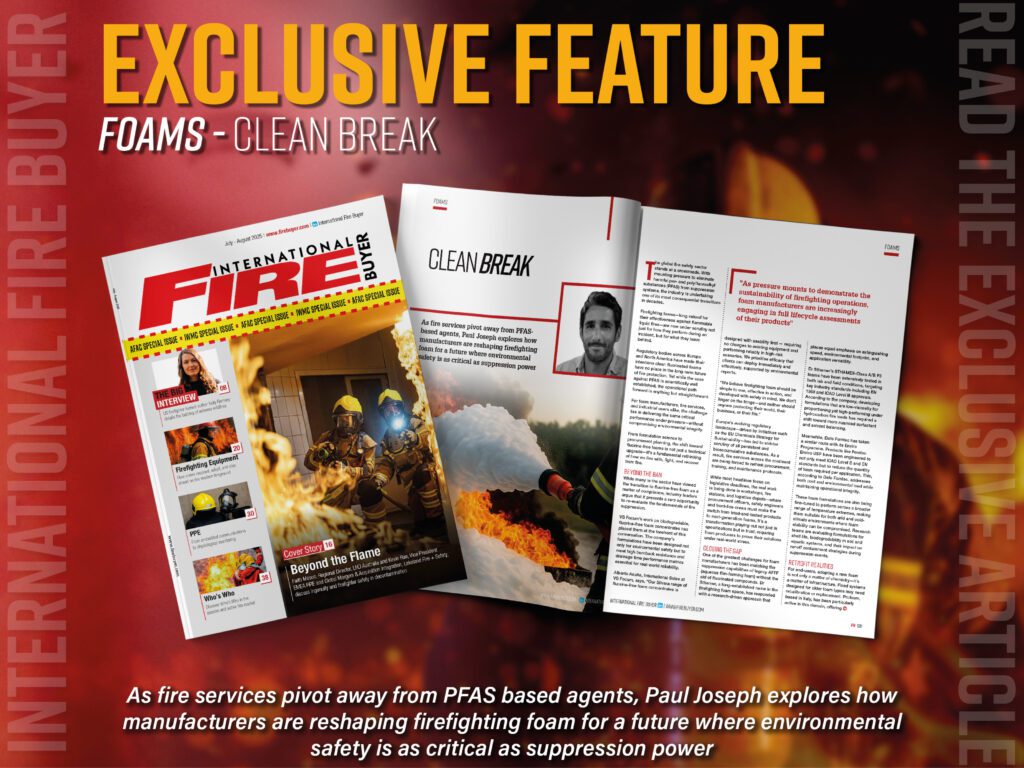
Foam – Clean Break

As fire services pivot away from PFAS-based agents, Paul Joseph explores how manufacturers are reshaping firefighting foam for a future where environmental safety is as critical as suppression power. The global fire safety sector stands at a crossroads. With mounting pressure to eliminate harmful per- and polyfluoroalkyl substances (PFAS) from suppression systems, the industry is undertaking one of its most consequential transitions in decades. Firefighting foams—long valued for their effectiveness against flammable liquid fires—are now under scrutiny not just for how they perform during an incident, but for what they leave behind. Regulatory bodies across Europe and North America have made their intentions clear: fluorinated foams have no place in the long-term future of fire protection. Yet while the case against PFAS is scientifically well established, the operational path forward is anything but straightforward. For foam manufacturers, fire services, and industrial users alike, the challenge lies in delivering the same critical performance under pressure—without compromising environmental integrity. From formulation science to procurement planning, the shift toward fluorine-free foams is not just a technical upgrade—it’s a fundamental rethinking of how we live with, fight, and recover from fire. Beyond the ban While many in the sector have viewed the transition to fluorine-free foam as a matter of compliance, industry leaders argue that it presents a rare opportunity to re-evaluate the fundamentals of fire suppression. VS Focum’s work on biodegradable, fluorine-free foam concentrates has placed them at the forefront of this conversation. The company’s formulations have been designed not only for environmental safety but to meet high burnback resistance and drainage time performance metrics essential for real-world reliability. Alberto Acuña, International Sales at VS Focum, says, “Our Silvara range of fluorine-free foam concentrates is designed with usability first — requiring no changes to existing equipment and performing reliably in high-risk scenarios. We prioritise efficacy that clients can deploy immediately and effectively, supported by environmental reports. “We believe firefighting foam should be simple to use, effective in action, and developed with safety in mind. We don’t linger on the fringe—and neither should anyone protecting their world, their business, or their life.” Europe’s evolving regulatory landscape—driven by initiatives such as the EU Chemicals Strategy for Sustainability—has led to stricter scrutiny of all persistent and bioaccumulative substances. As a result, fire services across the continent are being forced to rethink procurement, training, and maintenance protocols. While most headlines focus on legislative deadlines, the real work is being done in workshops, fire stations, and logistics depots—where procurement officers, safety engineers and front-line crews must make the switch from tried-and-tested products to next-generation foams. It’s a transformation playing out not just in specifications but in trust, requiring foam producers to prove their solutions under real-world stress. Closing the gap One of the greatest challenges for foam manufacturers has been matching the suppression capabilities of legacy AFFF (aqueous film-forming foam) without the aid of fluorinated compounds. Dr Sthamer, a long-established name in the firefighting foam space, has responded with a research-driven approach that places equal emphasis on extinguishing speed, environmental footprint, and application versatility. To read the full article see our latest issue here.

Foam – Clean Break Read More »

Picture of IWMC logo - Photo by IWMA - Fire Buyer

What to Expect: IWMC 2025

Manchester hosts a pivotal moment for fire suppression innovation as the International Water Mist Conference convenes global experts, fresh research, and critical industry debate. The 24th International Water Mist Conference (IWMC) will take place in Manchester, UK, on 24th and 25th September 2025, marking a critical opportunity for fire safety professionals, engineers, researchers, and policy makers to explore the state of play in water mist technology. Organised by the International Water Mist Association (IWMA), the conference promises a forward-facing agenda across 24 presentations and a keynote panel on UK standardisation, with attendees from industry, academia, and regulatory sectors. As the fire safety landscape shifts in response to decarbonisation, urban densification, and new building technologies, IWMC 2025 positions water mist systems at the intersection of performance, sustainability, and resilience. Across two days, delegates will gain insight into new applications, evolving standards, and the engineering realities of deploying mist systems in demanding scenarios. Modern challenges Key sessions this year highlight how water mist is responding to some of today’s most pressing built environment challenges. Among the standout case studies is the recently completed fire suppression retrofit in the Notre Dame Cathedral. Following the devastating 2019 blaze, high-pressure water mist was selected by project leads as the optimal solution for balancing fire protection with architectural sensitivity. Antti Hurme, Senior Manager at Marioff, will detail the project’s technical hurdles, from preserving heritage features to adapting hydraulic designs within a centuries-old structure. Notably, Notre Dame is the first cathedral in France to be protected by this type of system. Elsewhere, the vertical city comes into focus. As Managing Director of Fixed Firefighting Systems at Fogtec, Rüdiger Kopp will explore the role of water mist in high-rise buildings, where evacuation complexities and system constraints present major challenges. Using Berlin’s Gasometer building at the EUREF Campus as a focal point, Kopp will unpack design considerations, VdS 3188 compliance, and real-world performance metrics achieved during rigorous fire testing. His presentation reinforces the suitability of high-pressure mist for tall structures, citing reduced pump requirements, faster suppression, and minimal water damage. Several IWMC 2025 sessions will also explore the tension between preservation and protection, particularly in buildings with heritage designation or mixed-use occupancy. Fire engineers are increasingly tasked with reconciling modern suppression needs with historic architecture or multipurpose floorplans. Presentations in this area will examine hybrid system integration, nozzle placement strategies, and hydraulic considerations in restricted or sensitive environments. Digital demands and energy transitions With artificial intelligence driving exponential data centre growth, new fire risks are emerging from high-density racks, immersion cooling, and lithium-ion battery units. Riccardo Cerati, Sales Director EMEA at VID Firekill, will argue that legacy sprinkler infrastructure is no longer fit for these rapidly evolving sites. His session presents water mist as a flexible, effective alternative that can adapt to new layouts and thermal risks. Emphasising the pace of transformation, Cerati calls for design strategies that anticipate rather than react to these changes. To read the full article see our latest issue here.

What to Expect: IWMC 2025 Read More »

Firefighting equipment – Smarter Under Pressure

As fires grow in scale and complexity, smarter, integrated equipment is redefining how crews respond, adapt, and stay ahead on the modern fireground. Rebecca Spayne investigates. The landscape of fire response is changing rapidly. With climate, driven wildfires, expanding urban interfaces, and rising expectations for firefighter safety, equipment is being redefined, not just improved. Today’s tools must do more than endure; they must think, adapt, and integrate. Across the sector, a quiet revolution is underway. From hose design to pump intelligence, the future of firefighting lies in systems that are not only stronger but smarter. Among the most telling examples is the evolution of hose technology. High, performance layflat hoses, such as those developed by Gollmer & Hummel, now combine high burst pressure with exceptional kink resistance and lightweight builds. These features are designed not just for durability, but to reduce firefighter fatigue over long hauls. Meanwhile, broader ranges of attack and supply line solutions are focusing on ergonomic couplings and greater flow efficiency. Manufacturers like Kochek are leading efforts to improve couplings and hydrant connections. These aren’t aesthetic upgrades; they are designed responses to the physical toll and operational speed demanded by modern incidents. Water delivery, once seen as a simple matter of pressure and quantity, has entered the age of system intelligence. At the core of this transformation is the integration of pump control and flow regulation. By automating key decisions, pressure regulation, intake switching, and hose line management, advanced systems reduce human error and give incident commanders a real, time picture of water dynamics. In high, stakes environments where seconds matter, automation isn’t a luxury; it’s a safety net. Paired with such systems, proportioning has also seen advances. Mechanical dosing pumps such as those from FireMiks now offer a compelling solution to foam application challenges. Operating entirely from water flow, these units eliminate the need for external power sources while ensuring precise additive injection, particularly relevant where rapid deployment and reliability outweigh digital finesse. Smart flow control solutions from providers like SAMFlows further enhance system coordination, synchronising pumps and valves with intuitive interfaces that support multi, hose deployment and adaptive intake control in dynamic field scenarios. “SAMFlows is system that brings intelligent controls to vehicle pump operations,” says Guy Jackson, product manager for SAMFlows. “Developed with the aim of preventing mistakes and errors in pump operations, the system manages water supplies into the pump, ensuring seamless transition from one water source to another so that branch operators get the water they need as long as it is available from one source (tank, hydrant or open water). “Pump pressure is automatically managed according to the demands put on the pump and individual discharge pressures are delivered and maintained without the need for the pump operator to monitor.” But the shift isn’t just about individual components, it’s about integration. As departments invest in smarter pumps, sensors, and digital dashboards, the days of standalone hardware are numbered. Innovative monitors and nozzles, such as those produced by Elkhart Brass, are increasingly including wireless controls, flow indicators, and compatibility with truck, based data platforms. The focus is on simplifying interface complexity while expanding tactical options, making every drop count without overwhelming the user. System, level design, where detection, control, and discharge are unified, further highlights the potential for cross, sector learning. As structural and industrial fire challenges evolve, lessons from high, resilience environments like marine and offshore operations are being brought ashore. To read the full article see our latest issue here.

Firefighting equipment – Smarter Under Pressure Read More »

Cover Story – Lakeland

Faith Mason, Regional Director, LHD Australia and Kevin Rae, Vice President EMEA FIRE and Global Mergers & Acquisition Integration, Lakeland, discuss ingenuity and firefighter safety in decontamination. In July 2024, Lakeland Industries completed the acquisition of LHD Group, adding a major global brand in fire turnout gear and a proven leader in PPE care services to its portfolio. The move brought together manufacturing scale, R&D capability, and specialist operational expertise to advance firefighter safety on a global level. At the forefront of this integration are Kevin Rae, Vice President EMEA FIRE and Global Mergers & Acquisition Integration at Lakeland, and Faith Mason, Regional Director at LHD Australia. Their combined insights highlight how the partnership is driving innovation in PPE design, lifecycle management, and decontamination. This feature explores the technical and operational strategies shaping their work, from rigorous contamination removal to extending garment life and adapting proven service models worldwide. Kevin explained that Lakeland’s long-term objective has been clear. “Lakeland Industries has had a vision to create a business and a collective of major brands to really work and integrate into the fire industry with a worldwide footprint.” The addition of LHD Group, with its operations in Germany, Hong Kong and Australia, was a significant step toward becoming, as he described, “a global first responder safety leader.” From the outset, LHD’s Australian operation stood out for its specialist capability in PPE care. “In the Australian market, the area of decontamination services, which is called LHD Care, was a major interest,” Kevin said. “It is about the decontamination, repair, maintenance and lifecycle management of the fire kit. It is far more than simply washing garments.” Faith has seen that service evolve over her two decades with the company. “It is no longer just a support or a bonus to buy the suits,” she explained. “It is a specific service that stands on its own.” What began in 2002 as a partnership offering PPE sales alongside cleaning and maintenance has grown into a dedicated operation backed by advanced processes and software. “The software is the real game changer,” she said. “It drives the system and allows customers to track their garments in real time.” Kevin described the integration as a two-way exchange. “We are all in a melting pot together… taking some of their experiences and some of the experiences we have in other environments and bringing a global view on research and development.” For Faith, the merger is also about opportunity. “In Australia we have large state-based government run agencies. In other regions the structure is very different, so it is about understanding those differences and working out how the service can be structured to meet them.” To read the full article see our latest issue here.

Cover Story – Lakeland Read More »

Big Interview – Kelly Ramsey

Paul Joseph, Editor of Fire Buyer, talks to U.S. firefighter-turned-author Kelly Ramsey about what it really takes to battle wildfires—and the policy reforms the industry still needs.  When Kelly Ramsey joined an elite U.S. hotshot crew in 2020, she brought with her not just the grit demanded by the job, but a determination to prove that wildland firefighting could be a space where women thrive. As one of the oldest—and the only woman—on the crew, Kelly faced a daunting physical and emotional challenge. Her first deployment, on Arizona’s Bush Fire, was a sensory shock: “The first time you really see flames as tall as a house or flames as tall as a high rise on a ridge… it just leaves you awestruck,” she recalls. “I was there with my mouth hanging open, just thinking: What have I gotten myself into?” What followed were two intense fire seasons marked by megafires, fatigue, and a steep learning curve. Her gripping memoir, Wildfire Days: A Woman, a Hotshot Crew, and the Burning American West, offers an unflinching account of those years, drawing out not only the physical demands but the psychological toll exacted by life on the line. Kelly didn’t initially set out to write a book. During her fire seasons, she kept detailed notes to process the day’s events. “When I finished my second season, I realised I had 50,000 words,” she says. “I just started filling in the scenes, writing out everything that happened. And when I started, I just couldn’t stop.” “There was this sense that I had something I needed to get down,” she says. “And then all this stuff about my family—my father, his alcoholism—it all started coming to the surface.” Through her writing, she also raises critical questions about culture, gender, and mental health in a profession still shaped by masculine archetypes. “In firefighting of all places, I felt like I found my real family,” she says. “Having come from a really difficult family of origin, I had been looking for many, many years for my real family. And in firefighting, I felt like I found that.” “It’s about belonging,” she adds. “So many of us are looking for somewhere that we belong. For me, unexpectedly, that happened in fire.” Yet, that family came with conditions: proving physical worth, absorbing intense emotional pressures, and surviving in a system that isn’t built for everyone. “People are very much specialised into roles,” she explains. “Once you’re assigned to that role for the season, that’s your job. If you’re third in line with a Pulaski, you’re ‘third P’—that’s your job, that’s where you go.” That rigidity can be a source of pride and identity—but also a limitation. “Someone might be moved up if, say, a Sawyer gets injured or has to leave for a family emergency, but generally you stay in your assigned place. It’s not designed for adaptability, and that can wear on people.” As the wildfire crisis escalates, Kelly believes that flexibility—both physical and institutional—will be key. To read the full article see our latest issue here.

Big Interview – Kelly Ramsey Read More »

Ask the Expert – Johnson Controls

Rebecca Spayne of Fire Buyer sits down with Chris Downing, Global Director of Fire Codes & Standards at Johnson Controls, to discuss tailored fire protection strategies for data centres. Data centres are unique, high-value environments where downtime can have huge consequences. How do fire protection systems support both operational continuity and efficiency in this sector? There’s a misconception about what a “data centre” is. People often picture hyperscale facilities run by the big cloud providers, but data can be anything from a single server cupboard in a small office to an enterprise-owned facility on a company’s premises. In fact, around 45% of data centres are still enterprise-owned rather than co-located or hyperscale. Regardless of scale, these are critical environments, if they stop running, the business stops running. At their core, data centres are large electrical loads that convert power into processing, and in doing so, generate significant heat. Traditionally, we’ve managed this with forced air cooling, but airflow patterns in modern facilities have become more sophisticated to improve efficiency. That changes the way smoke behaves, as it no longer rises as predictably but can disperse rapidly, which makes both detection and protection more challenging. Emerging cooling methods like rear-door, cold plate (direct-to-chip) or immersion cooling will add further complexity; though they won’t replace existing systems overnight they will likely creep into the same protected space. Fire protection in these environments has to achieve two things: it must detect and act upon a fire before it causes damage, and often must do so without creating unacceptable downtime. That means being future-proof and flexible enough to adapt to evolving cooling methods and layouts. It’s not enough to simply replicate what worked in the past; protection strategies must be designed for the airflow, cooling, and operational profile of the specific site. What’s the right starting point when designing fire protection for a data centre? Before talking about technologies, a data centre client needs to be honest about their risk tolerance. Picture three rows of racks in a single room. If one catches fire, what does the client expect to happen? In some parts of the world, such as the United States, the code may require sprinklers as a minimum, without them, you simply can’t operate. In other regions, sprinklers might not be mandated at all. The key question is whether a sprinkler system alone is good enough? In my view, not if you want true operational continuity. Data centre racks tend to act like umbrellas, water won’t easily penetrate, so you have to assume a total loss of any rack that ignites, and potentially that whole contiguous row. Sprinklers should control the spread to other rows, but they won’t prevent the loss of equipment in the one that’s burning. For some operators with extensive redundancy, that may be acceptable. For others, it could be a non-starter. If the goal is to keep the power on and the business running even during an incident, a gaseous extinguishing system is often the right choice. Unlike sprinklers, gaseous systems can extinguish a fire inside a rack without needing the power cut, preventing both damage and downtime. That’s why, for mission-critical environments, I always start by asking: can you afford to turn the power off? If the answer is no, sprinklers alone probably aren’t the right answer. To read the full article see our latest issue here.

Ask the Expert – Johnson Controls Read More »

Scroll to Top