
John McGrath, Business Development Manager, at ACEDES LLC explains how its intelligent detection and cooling technology prevents fires in recycling facilities
Fires in waste management and recycling facilities have become increasingly common, driven by the surge in discarded lithium-ion batteries from consumer electronics, vapes, and power tools.
Even a single damaged cell can ignite, setting off a chain reaction of costly damage and operational downtime. According to data from waste360.com, the number of reported fires in waste facilities has grown steadily since 2018, at a rate of about 12 additional fires each year, and this rate appears to be accelerating.
As John McGrath, Business Development Manager at ACEDES LLC, explains, the key to tackling this challenge is not merely extinguishing fires, but preventing them from developing in the first place.
“Our objective is to stop those fires before they even become fires,” he says. “Once you’re at the point of needing a sprinkler system, you’ve already suffered operational disruption and damage.”
ACEDES’ system represents a shift from traditional suppression methods to intelligent, autonomous prevention that does not depend on a person having to assess the situation either on site or remotely, reducing any delays.
Two Proven Technologies; One Solution
ACEDES is the product of collaboration between two leading German fire safety engineering companies, Orglmeister, renowned for intelligent infrared detection systems capable of identifying heat sources long before flames appear, and Firedos, specialists in foam proportioners and fire monitors.
Both companies recognised the growing market demand for early detection and rapid response systems in North America, leading them to establish ACEDES, headquartered in Houston, Texas.
“ACEDES stands for Autonomous Coupled Early Detection and Extinguishing Systems,” McGrath explains. “It’s designed to detect, target, and cool hotspots before they ignite.”
The company’s flagship technology, FalconEx™ combines the PYROsmart® pro, and Orglmeister’s thermal IR, video and AI detection algorithms with Firedos’ high-precision water monitors. The result is an integrated fire prevention solution for high-risk environments such as recycling plants, transfer stations, and industrial waste facilities.
How It Works
At the heart of the ACEDES system is the PYROsmart® pro system that incorporates infrared and traditional sensors, which continuously scans large indoor or outdoor areas using a combination of thermal and visual imaging. Unlike static flame or smoke detectors that rely on visible combustion, the infrared system detects elevated temperatures at the earliest stage of thermal development. Furthermore, it doesn’t suffer from delays in waiting for off-site humans to respond to alarms as the system has already qualified the areas that need action.
The unit pans and tilts across the monitored space, building a three-dimensional thermal map with extreme precision. In a conventional system installation, it can achieve pixel resolutions of just 1.4 square inches, compared with roughly 140 square inches for standard flame detectors, a 100-fold improvement in resolution.
“The system runs 24/7 continually updating the composite IR and video image in real time,” says McGrath.
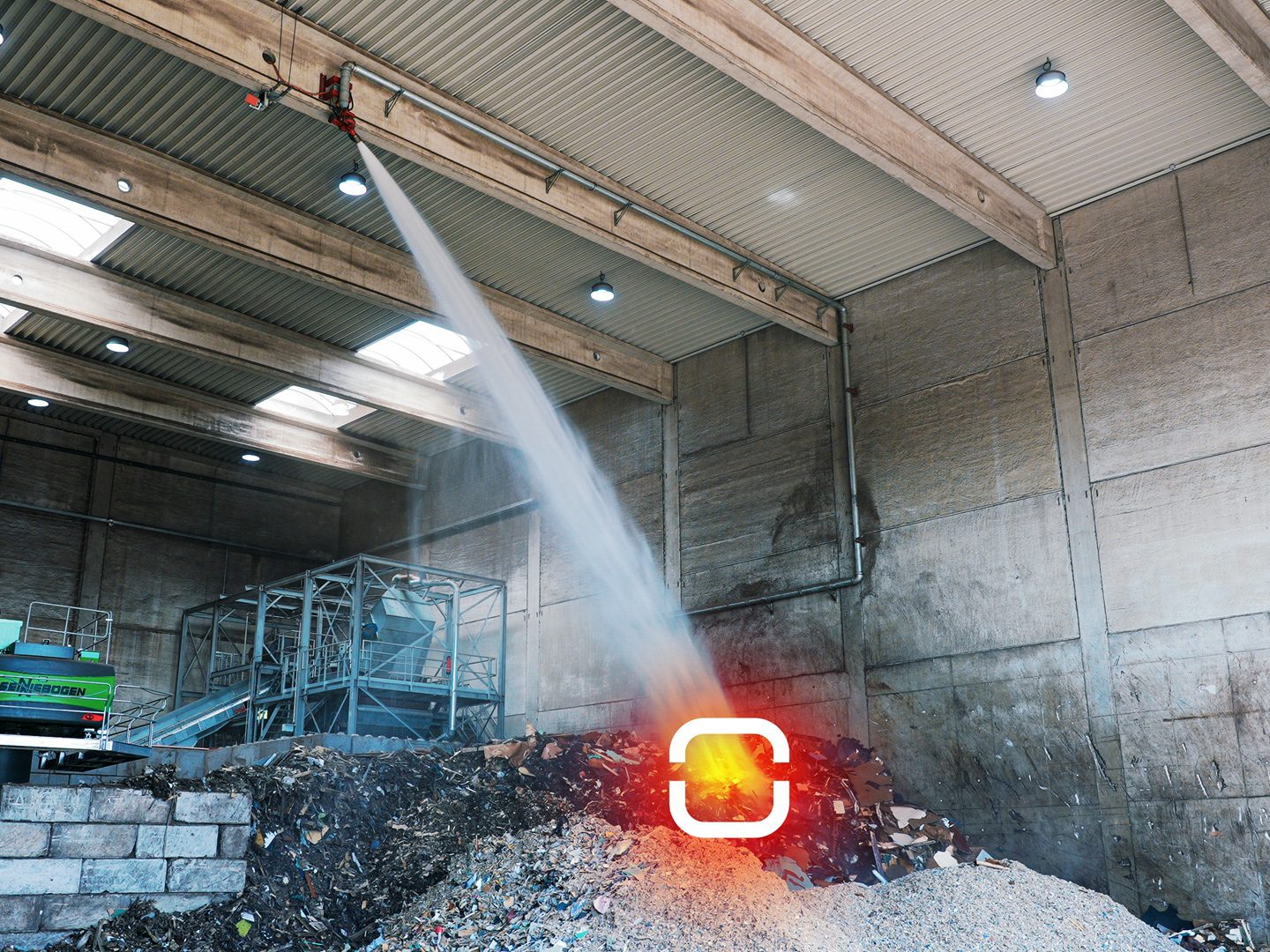
When a hotspot is detected, the system calculates its X, Y, and Z coordinates in 3D space. This data is transmitted to a monitor controller, which automatically aims and activates a water monitor directed precisely at the hotspot. The monitor follows a pre-programmed spray pattern, cooling the affected area systematically rather than merely dousing a single point, while the PYROsmart® pro continues scanning the rest of the area.
TO READ THE FULL ARTICLE SEE OUR LATEST ISSUE HERE