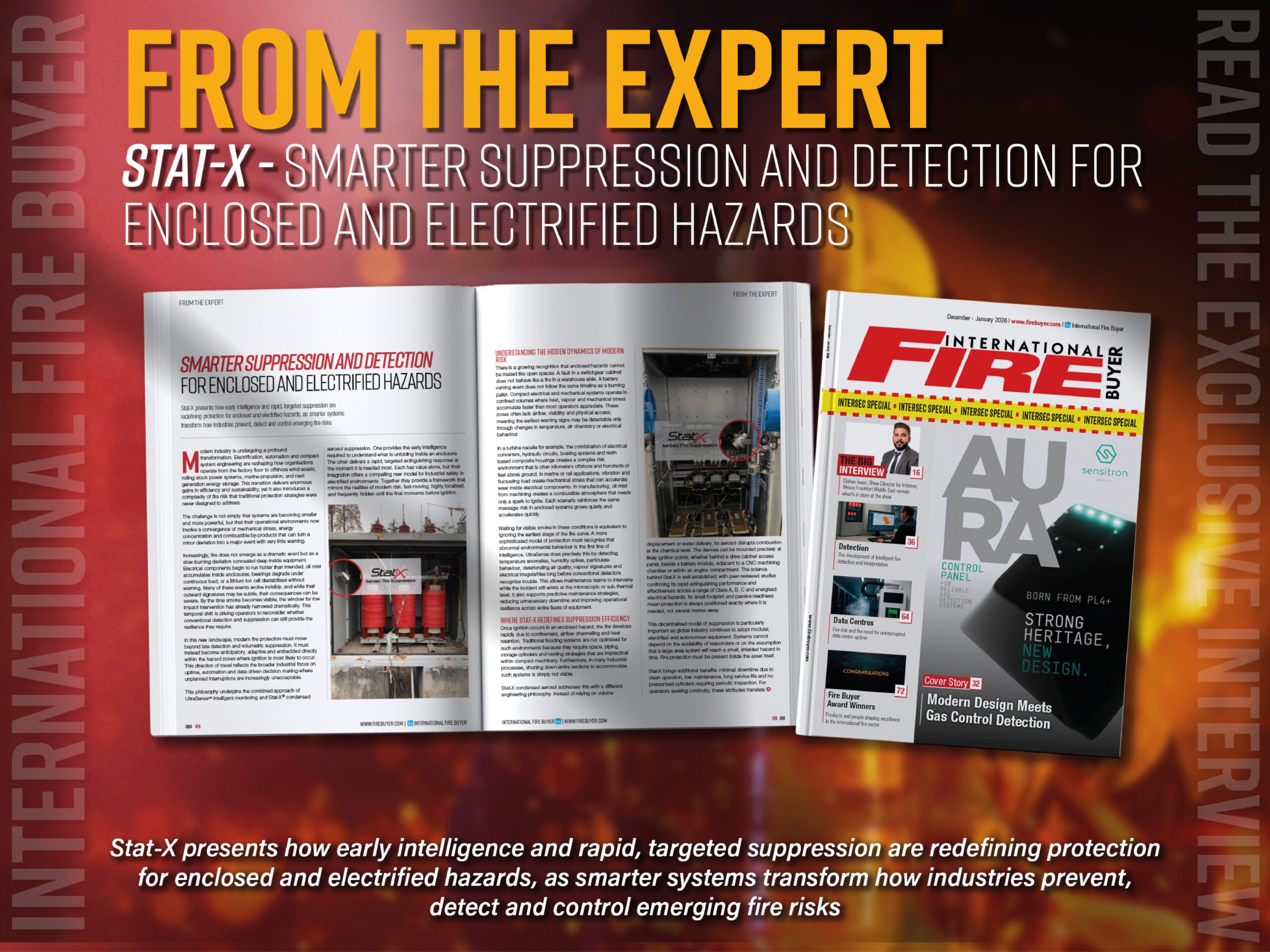

Early intelligence and rapid, targeted suppression are redefining protection for enclosed and electrified hazards, as smarter systems transform how industries prevent, detect and control emerging fire risks
Modern industry is undergoing a profound transformation. Electrification, automation and compact system engineering are reshaping how organisations operate from the factory floor to offshore wind assets, rolling stock power systems, marine propulsion, and next generation energy storage. This transition delivers enormous gains in efficiency and sustainability, yet it also introduces a complexity of fire risk that traditional protection strategies were never designed to address.
The challenge is not simply that systems are becoming smaller and more powerful, but that their operational environments now involve a convergence of mechanical stress, energy concentration and combustible by-products that can turn a minor deviation into a major event with very little warning.
Increasingly, fire does not emerge as a dramatic event but as a slow-burning deviation concealed deep inside equipment. Electrical components begin to run hotter than intended, oil mist accumulates inside enclosures, bearings degrade under continuous load, or a lithium ion cell destabilises without warning. Many of these events evolve invisibly, and while their outward signatures may be subtle, their consequences can be severe. By the time smoke becomes visible, the window for low impact intervention has already narrowed dramatically. This temporal shift is driving operators to reconsider whether conventional detection and suppression can still provide the resilience they require.
In this new landscape, modern fire protection must move beyond late detection and volumetric suppression. It must instead become anticipatory, adaptive and embedded directly within the hazard zones where ignition is most likely to occur. This direction of travel reflects the broader industrial focus on uptime, automation and data-driven decision making where unplanned interruptions are increasingly unacceptable.
This philosophy underpins the combined approach of UltraSense intelligent monitoring and Stat-X condensed aerosol suppression. One provides the early intelligence required to understand what is unfolding inside an enclosure. The other delivers a rapid, targeted extinguishing response at the moment it is needed most. Each has value alone, but their integration offers a compelling new model for industrial safety in electrified environments. Together they provide a framework that mirrors the realities of modern risk: fast-moving, highly localised, and frequently hidden until the final moments before ignition.
TO READ THE FULL ARTICLE SEE OUR LATEST ISSUE HERE: