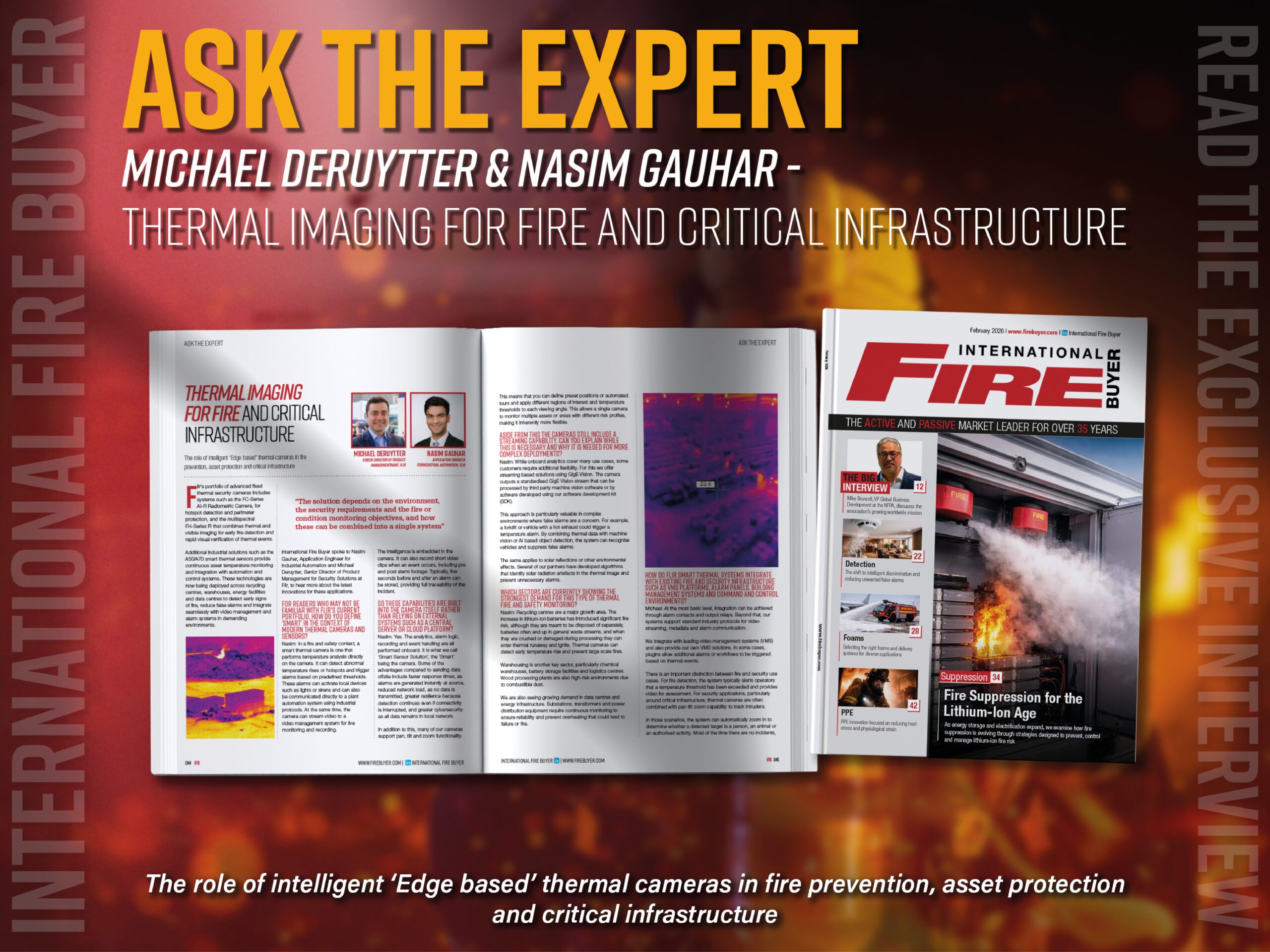

Nasim Gauhar, Application Engineer for Industrial Automation and Michael Deruytter, Senior Director of Product Management for Security Solutions at Flir, discuss the role of intelligent ‘Edge based’ thermal cameras in fire prevention, asset protection and critical infrastructure.
Flir’s portfolio of advanced fixed thermal security cameras includes systems such as the FC-Series AI-R Radiometric Camera, for hotspot detection and perimeter protection, and the multispectral FH-Series R that combines thermal and visible imaging for early fire detection and rapid visual verification of thermal events.
Additional industrial solutions such as the A50/A70 smart thermal sensors provide continuous asset temperature monitoring and integration with automation and control systems. These technologies are now being deployed across recycling centres, warehouses, energy facilities and data centres to detect early signs of fire, reduce false alarms and integrate seamlessly with video management and alarm systems in demanding environments.
For readers who may not be familiar with Flir’s current portfolio, how do you define ‘smart’ in the context of modern thermal cameras and sensors?
Nasim: In a fire and safety context, a smart thermal camera is one that performs temperature analysis directly on the camera. It can detect abnormal temperature rises or hotspots and trigger alarms based on predefined thresholds.
These alarms can activate local devices such as lights or sirens and can also be communicated directly to a plant automation system using industrial protocols. At the same time, the camera can stream video to a video management system for live monitoring and recording.
The intelligence is embedded in the camera. It can also record short video clips when an event occurs, including pre and post alarm footage. Typically, five seconds before and after an alarm can be stored, providing full traceability of the incident.
So these capabilities are built into the camera itself rather than relying on external systems such as a central server or cloud platform?
Nasim: Yes. The analytics, alarm logic, recording and event handling are all performed onboard. It is what we call ‘Smart Sensor Solution’ – the ‘Smart’ being the camera. Some of the advantages compared to sending data offsite include faster response times, as alarms are generated instantly at source, reduced network load, as no data is transmitted, greater resilience because detection continues even if connectivity is interrupted, and greater cybersecurity as all data remains in local network.
In addition to this, many of our cameras support pan, tilt and zoom functionality. This means that you can define preset positions or automated tours and apply different regions of interest and temperature thresholds to each viewing angle. This allows a single camera to monitor multiple assets or areas with different risk profiles, making it inherently more flexible.
TO READ THE FULL ARTICLE READ THE LATEST ISSUE HERE.