
By Doug Dafler, Director of Sales- Fire (US), Lakeland Industries and Lee Glanville Rothman, Business Development Manager, Global-Pacific Helmets.
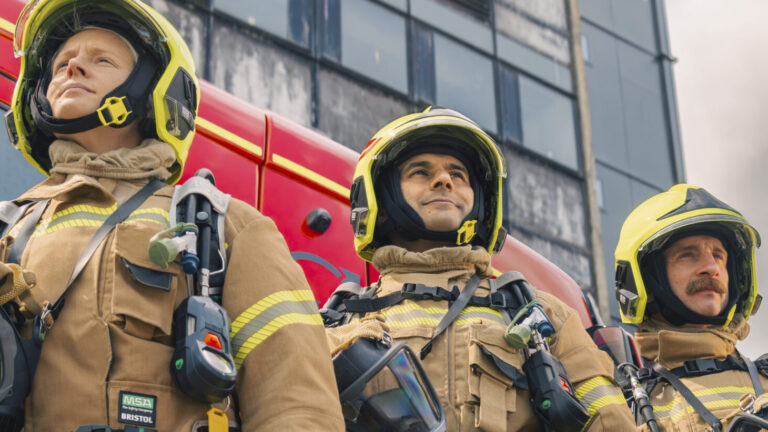
As the demands on firefighters and first responders evolve, so too must the standards and strategies used to define, evaluate, and deliver personal protective equipment. The unification of standards, as seen in the development of the 2025 editions of NFPA 1970, NFPA 1950, and NFPA 1955, reflects a shift toward a more holistic view of protective ensembles and equipment. By consolidating previously distinct standards into system-oriented frameworks, NFPA has taken steps to improve testing consistency and enable better integration across gear categories, from head to toe.
NFPA standards are technically rigorous and are designed to ensure safety under the most extreme conditions specific to their intended use. Structural firefighting gear, for example, undergoes testing protocols completely distinct from wildland firefighting gear, with each standard, such as NFPA 1970 and NFPA 1950, written to support these functional differences. This allows manufacturers to build products that are not only compliant but also suited to the environment and task at hand, delivering gear that is fit for purpose.
However, evaluating fit for purpose in the field is more complex. While NFPA standards define the parameters for performance and safety, fire departments operate within practical constraints. Budget limitations often prevent the purchase of multiple ensembles tailored to different response types. Structural firefighting gear may be used for vehicle extrication, rescue, or field fires—not because it is the most suitable choice, but because it is the only one available. In some departments, fewer than 20% of calls involve structural fires, yet structural PPE remains the primary uniform for all scenarios.
This highlights a broader tension between certification and application. NFPA certification is a requirement for manufacturers seeking market credibility and compliance. In some states, it is legislated. In others, individual departments determine their approach based on risk assessments and operational needs. While many still prefer NFPA-certified products, it is not uncommon to find non-compliant gear in active use. In these cases, product selection is often driven more by wear trials and field-based realities than by certification standards.
Manufacturers must therefore design PPE that meets evolving standards while remaining practical and cost-effective for real-world use. The challenge is to create durable, compliant gear that balances the intent of the standard with the real-world experience of the user. That means responding not only to technical requirements, but also to how gear fits, functions, and interacts with the human body. Good PPE does not just protect—it enables performance. Comfort, adjustability, and inclusivity across different body types all contribute to safety by reducing distraction, fatigue, and ergonomic risk.
The shift toward systems integration in standards invites renewed inquiry into each component. If an SCBA provides primary eye protection in a structural fire, is an integrated or external visor still essential on a helmet? Similarly, when a particulate-blocking hood is worn in combination with a helmet that includes an insulated ear flap, are we unintentionally contributing to heat stress through overprotection?