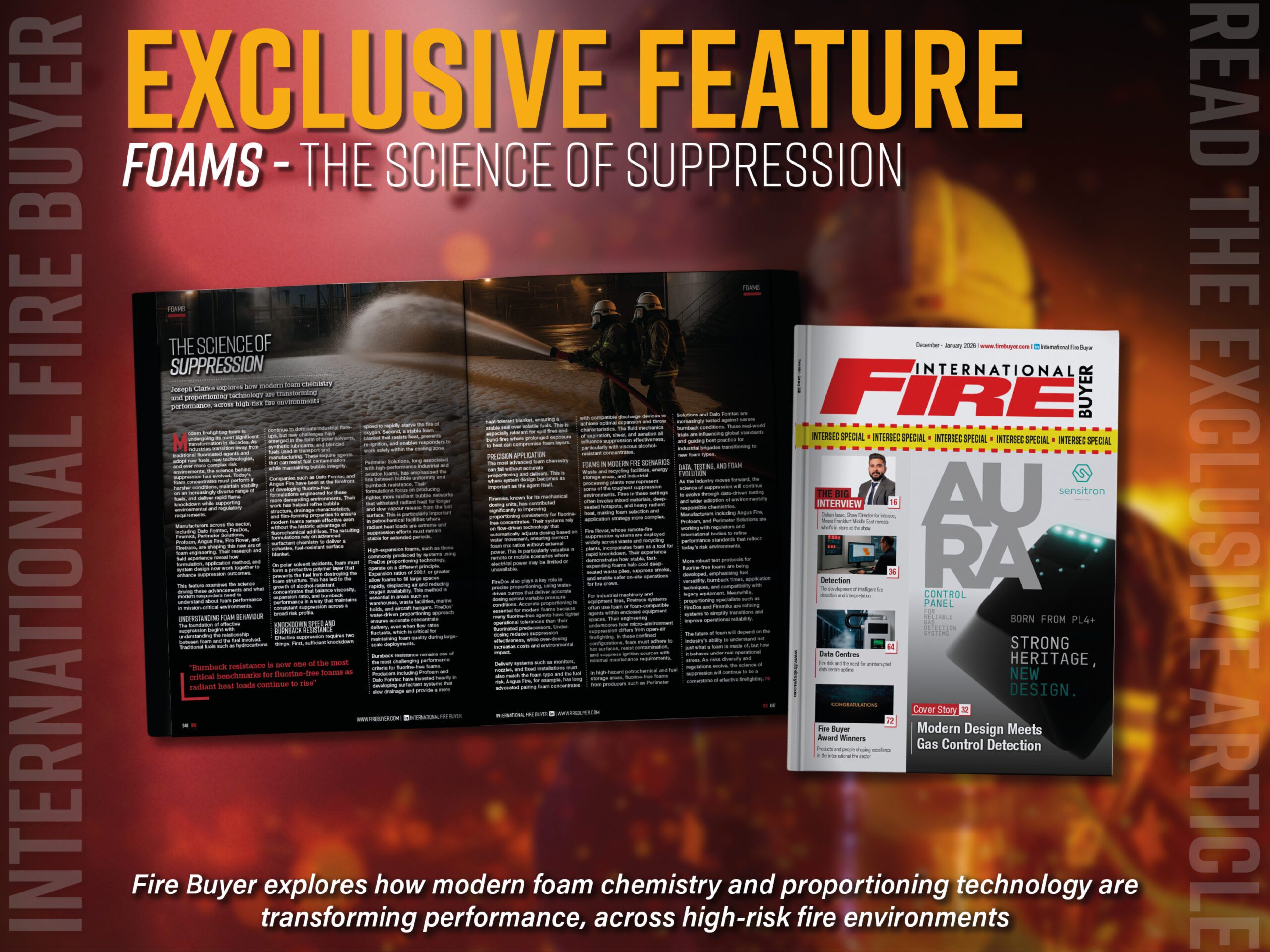

Joseph Clarke explores how modern foam chemistry and proportioning technology are transforming performance, across high-risk fire environments
Modern firefighting foam is undergoing its most significant transformation in decades. As industries transition away from traditional fluorinated agents and adopt new fuels, new technologies, and ever more complex risk environments, the science behind suppression has evolved. Today’s foam concentrates must perform in harsher conditions, maintain stability on an increasingly diverse range of fuels, and deliver rapid flame knockdown while supporting environmental and regulatory requirements.
Manufacturers across the sector, including Dafo Fomtec, FireDos, Firemiks, Perimeter Solutions, Profoam, Angus Fire, Fire Rover, and Firetrace, are shaping this new era of foam engineering. Their research and field experience reveal how formulation, application method, and system design now work together to enhance suppression outcomes.
This feature examines the science driving these advancements and what modern responders need to understand about foam performance in mission-critical environments.
Understanding Foam Behaviour
The foundation of effective suppression begins with understanding the relationship between foam and the fuel involved. Traditional fuels such as hydrocarbons continue to dominate industrial flare-ups, but new challenges have emerged in the form of polar solvents, synthetic lubricants, and blended fuels used in transport and manufacturing. These require agents that can resist fuel contamination while maintaining bubble integrity.
Companies such as Dafo Fomtec and Angus Fire have been at the forefront of developing fluorine-free formulations engineered for these more demanding environments. Their work has helped refine bubble structure, drainage characteristics, and film-forming properties to ensure modern foams remain effective even without the historic advantage of fluorochemical additives. The resulting formulations rely on advanced surfactant chemistry to deliver a cohesive, fuel-resistant surface blanket.
On polar solvent incidents, foam must form a protective polymer layer that prevents the fuel from destroying the foam structure. This has led to the growth of alcohol-resistant concentrates that balance viscosity, expansion ratio, and burnback performance in a way that maintains consistent suppression across a broad risk profile.
Knockdown Speed and Burnback Resistance
Effective suppression requires two things. First, sufficient knockdown speed to rapidly starve the fire of oxygen. Second, a stable foam blanket that resists heat, prevents re-ignition, and enables responders to work safely within the cooling zone.
Perimeter Solutions, long associated with high-performance industrial and aviation foams, has emphasised the link between bubble uniformity and burnback resistance. Their formulations focus on producing tighter, more resilient bubble networks that withstand radiant heat for longer and slow vapour release from the fuel surface. This is particularly important in petrochemical facilities where radiant heat loads are extreme and suppression efforts must remain stable for extended periods.
TO READ THE FULL ARTICLE SEE OUR LATEST ISSUE HERE