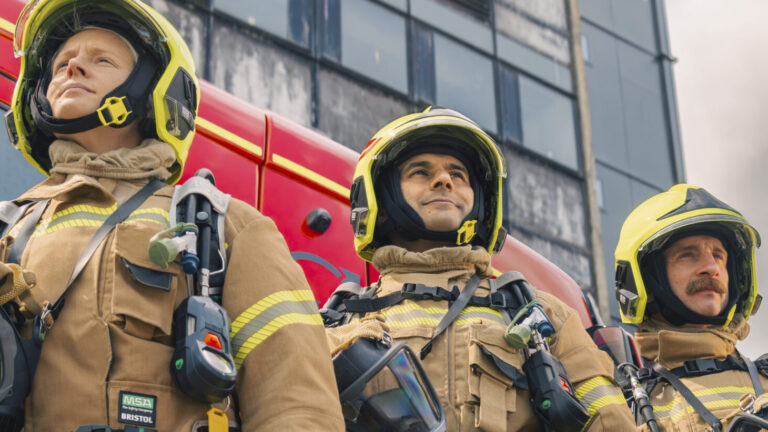

Jon Sharp, Specification Manager, MEIKO UK Protect and Care, discusses decontamination, PPE longevity and the role of engineered systems in fire service safety
Live on the MEIKO stand at The Emergency Services Show, Fire Buyer met with Specification Manager Jon Sharp to discuss decontamination technology first hand. The full video interview is available on firebuyer.com.
For readers who may not be familiar, who is MEIKO and what does the company specialise in?
MEIKO is a global manufacturer of cleaning and disinfection technology, founded in 1927 in Offenburg, Germany. For nearly a century, the company has been engineering solutions for hygiene-critical environments, from hospitality and healthcare to emergency services. Within the UK, MEIKO Protect and Care provides advanced decontamination technology designed specifically for first responders and fire services.
Our purpose is to protect those who protect others. We do that by developing systems that eliminate contaminants, carcinogens and harmful residues from personal protective equipment. When we talk about decontamination, we’re really talking about safeguarding lives, because the removal of carcinogens from PPE directly affects firefighter health and safety. That is why the technology has to perform consistently and precisely, every single time.
Decontamination is now a major talking point in the fire industry. Why is it so important to approach it with this level of engineering and consistency?
Decontamination is no longer optional; it’s a matter of duty of care. Firefighters are routinely exposed to toxic residues, hydrocarbons and particles that are carcinogenic. Those contaminants cling to gear and can remain active long after a fire is extinguished. If not properly removed, they can spread through vehicles, stations, and even into homes.
A structured, validated cleaning process ensures every piece of PPE is treated under controlled, repeatable conditions. It removes guesswork. Our systems use measured temperature, contact time, water flow and chemical dosing, all verified by sensors and programmed logic, that reaches up to 50 degrees Celsius according to the PPE manufacturer specifications. It is supported by an 85-litre tank and a 5.8-litre rinse, giving a balance between energy efficiency and effective disinfection. This means PPE is not only visibly clean but hygienically safe. The difference between a manual rinse and a controlled decontamination cycle can literally be the difference between risk and protection.
Let’s talk about the MEIKO TopClean D. What makes this machine stand out for fire services?
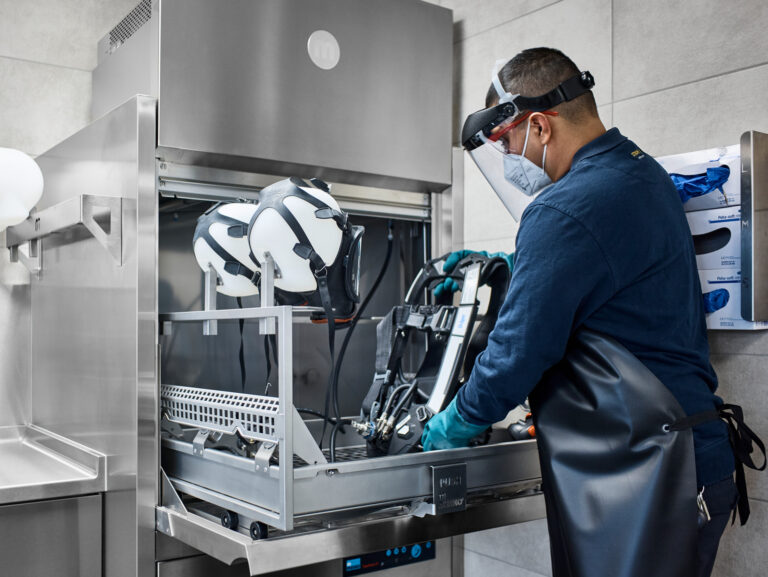
The MEIKO TopClean D is the flagship of our PPE decontamination line. It’s designed specifically for fire and rescue services handling multiple sets of breathing apparatus and protective gear. It combines volume capacity with repeatable performance.
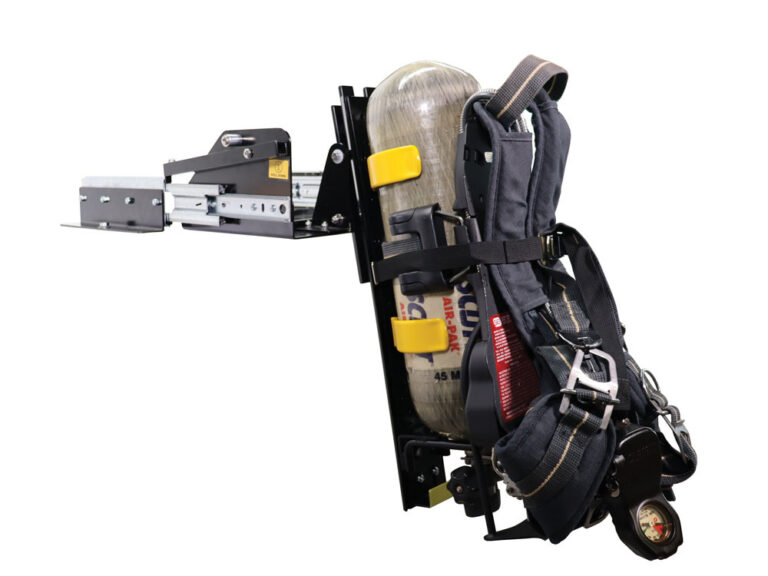
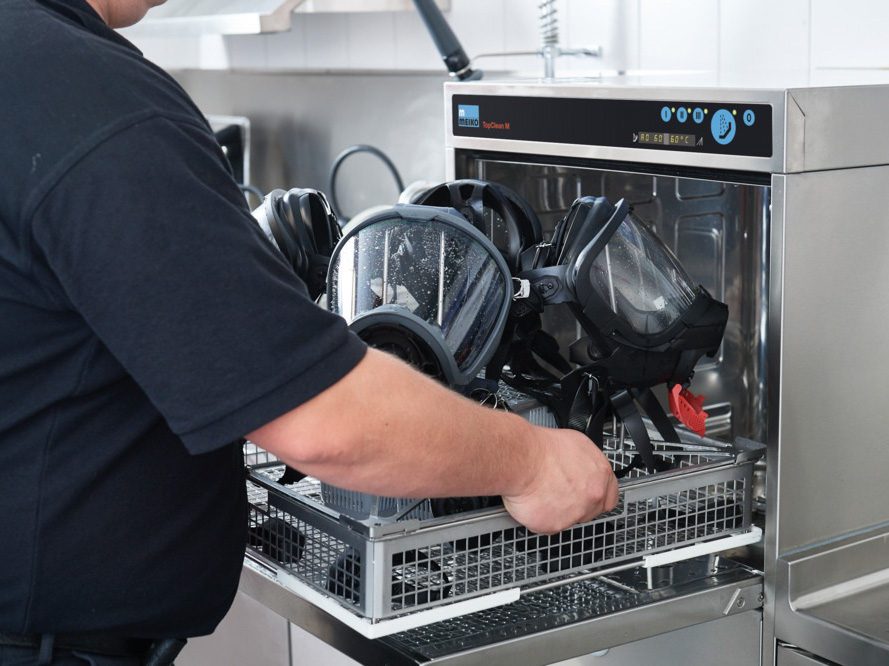
This machine can process up to four complete SCBA sets or twelve individual masks, harnesses and lung demand valves in one cycle. It operates with three pre-programmed cycles, 4, 8, and 16 minutes, depending on the level of contamination and the items being cleaned. The water temperature reaches around 47 to 48 degrees Celsius, supported by an 85-litre tank and a 5.8-litre rinse, giving a balance between energy efficiency and effective disinfection.
The key feature is flexibility. The pull-out rack is ergonomically designed so users can easily load and unload without strain. The interior racks can be adapted for different configurations, meaning stations can decontaminate BA sets, masks or even medical equipment components within the same system.
TO READ THE FULL ARTICLE SEE OUR LATEST ISSUE HERE