
From manual pumps to intelligent systems, firefighting technology now blends data, precision, and control to deliver modern reliability and performance. Rebecca Spayne discovers more.
Modern firefighting began not with engines or hoses, but with human rhythm and muscle. The bucket brigade, where citizens passed containers hand to hand, was the first organised method of fire suppression. By the 17th century, mechanical pumps began to replace this labour, evolving from wooden pistons and leather seals to brass and copper hand pumps capable of sustaining a directed stream. These machines, although primitive, marked the start of a continuous engineering journey driven by the same objective that defines the industry today: to move water efficiently, reliably, and under pressure.
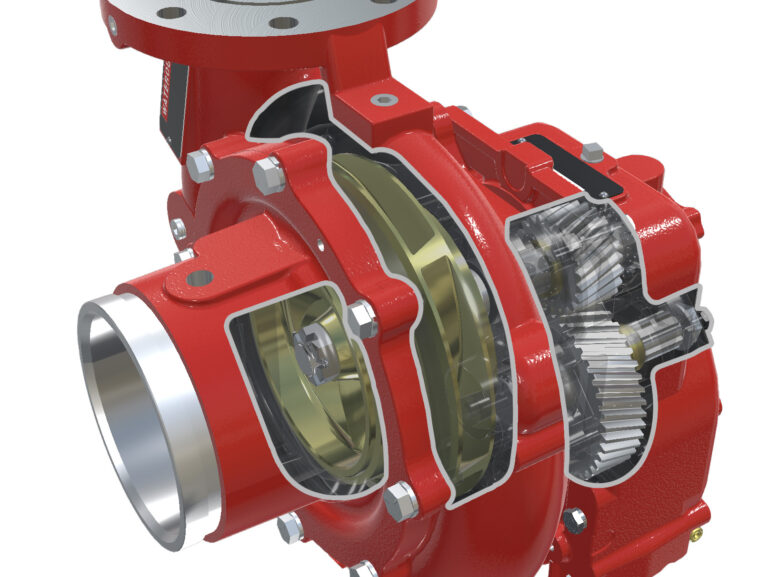
The 19th century saw the arrival of steam engines, which liberated firefighters from the limits of manpower. These steam pumps could deliver greater flow rates and, for the first time, allowed sustained operation during large urban fires. When the internal combustion engine arrived, centrifugal pumps became the defining feature of the modern fire appliance. The principle of mechanical pumps, rotational energy converted into hydraulic pressure, remains unchanged, but materials, tolerances, and design precision have advanced dramatically.
By the late 20th century, urbanisation, petrochemical expansion, and industrial risk demanded scale beyond traditional municipal systems. High-capacity pumps were no longer niche; they became essential to safeguarding refineries, storage depots, and critical infrastructure. The mechanical lineage from early piston pumps to today’s turbine-driven systems reveals an unbroken thread of refinement. Modern manufacturers such as US Fire Pump, Hytrans, FireMiks, Trident, and Godiva (IDEX) stand as inheritors of this legacy, each developing new solutions to the same timeless problem of pressure and flow, but within vastly different operational realities.
Building for Scale
The modern industrial fireground is measured in flow rate, not geography. As petrochemical complexes, tank farms, and logistics hubs expanded through the late twentieth century, so did the need for firefighting systems capable of moving unprecedented volumes of water and foam.
Municipal pumps designed for urban structures could not meet the hydraulic demands of these sprawling, high-risk environments. Into this gap stepped US Fire Pump, a manufacturer that redefined what scale means in mobile firefighting engineering.
Founded in Louisiana, US Fire Pump’s development philosophy centres on raw hydraulic output combined with operational adaptability. Its high-capacity pumps, routinely capable of flows exceeding 20,000 gallons per minute, are built not as stationary infrastructure but as modular assets that can be deployed wherever incident command requires.
At the core of US Fire Pump’s capability is an impeller and volute design informed by computational fluid dynamics. The company’s engineers prioritise hydraulic efficiency over brute mechanical force, using precision machining and multi-stage configuration to maintain pressure stability at extreme flow rates. This ensures consistent output under load, an essential factor when drawing from open sources, relay systems, or long-distance hose networks. Each system’s modularity also allows integration with different drive units, diesel, electric, or PTO-based, depending on the deployment environment.
TO READ THE FULL ARTICLE SEE OUR LATEST ISSUE HERE.