
The Montreal Airport Fire Department knows all too well how much every minute matters when it comes to saving lives aboard an aeroplane suddenly engulfed in flames. Months after undergoing hands-on-training at the Dallas/Fort Worth (DFW) International Airport Fire Training Research Centre, the team faced a real life scenario involving a plane that caught fire minutes after arriving at their airport. The incident began when a baggage conveyor belt vehicle burst into flames just after getting into contact with the aircraft by positioning in the belly hold area to offload baggage from the plane. Heavy smoke quickly filled the baggage compartment then the cabin area, where passengers were trying to de-plane. The flight crew ordered an immediate evacuation, prompting passengers to escape down the emergency slides.
Montreal airport fire-fighters got word of the emergency and responded immediately. They arrived to find the plane engulfed in smoke and possibly fire. Passengers were escaping down multiple inflatable slide chutes and running around the ramp area of the terminal. Instantly recognising the hazards at hand, the fire-fighters devised an action plan, taking into consideration the fire, smoke, status of passengers and location of the aeroplane at the gate. The fire-fighters then attacked the fire, quickly extinguishing it, keeping the damage limited to the smoke-filled cabin area of the plane and with no harm to passengers. Next, they grouped together the de-planed passengers and rescued them from the still hazardous area.
Knowing what to do and how to respond correctly in that scenario is all about muscle memory and familiarity according to the instructors at the DFW Airport Fire Training Research Centre (FTRC). These are critical skills that only practice and experience can teach. They are the very skills that airport fire-fighting teams from all over the world are mastering every day at the DFW Airport Fire Training Research Centre, considered the premier aircraft rescue fire-fighting (ARFF) training centre in the world. The Centre features several fire trainer aircraft mock-ups, including a mock-up of the world’s largest passenger airliner, the double-decker Airbus A380 with cargo, passenger and dual deck configurations—the only structural model of its kind.
The Montreal Airport fire-fighters spent two days of intense training at DFW Airport’s Fire Training Research Centre. The session began with state of the art classroom training in which the fire-fighters became familiar with the latest fire-fighting strategies and tactics, the inner workings aboard different aircraft, even the inner workings of their own airport. They can now do this thanks to the new cutting edge technology in place at the FTRC that has revolutionised the classroom training experience for fire-fighters. Instead of chalk boards, students can view video screens projecting 3D images of aeroplanes and their inner workings, as well as interactive maps of their home airport so they can visualise the scenarios as they would apply in a real-life scenario. Thanks to new computer software, instructors can access also access a computer touch screen at the podium to introduce near real time scenarios. Students can ‘react’ in near real time, too, via their own touch-screens as they sit at specially designed tables that simulate a four-person crew on call. It is through this interactive process that the fire-fighters begin to master muscle memory, one of the most critical fire-fighting skills of all.
The use of this same software also helps teach airport familiarsation. Fire-fighters have to learn how to navigate the runways and airfield while responding to an aircraft emergency at the same time. Again, thanks to the 3D images, fire-fighters have the ability to experience all the signage, markings and lighting as it appears on their own respective airfields. Flying down a simulated runway, a student can see the runway from the pilot’s perspective and understand how the topography cam impact pilots as well as fire-fighters. Instructors can present various scenarios and fire-fighters can respond accordingly, acting as a team, establishing effective thought processes and exercising muscle memory via their own computer screen.
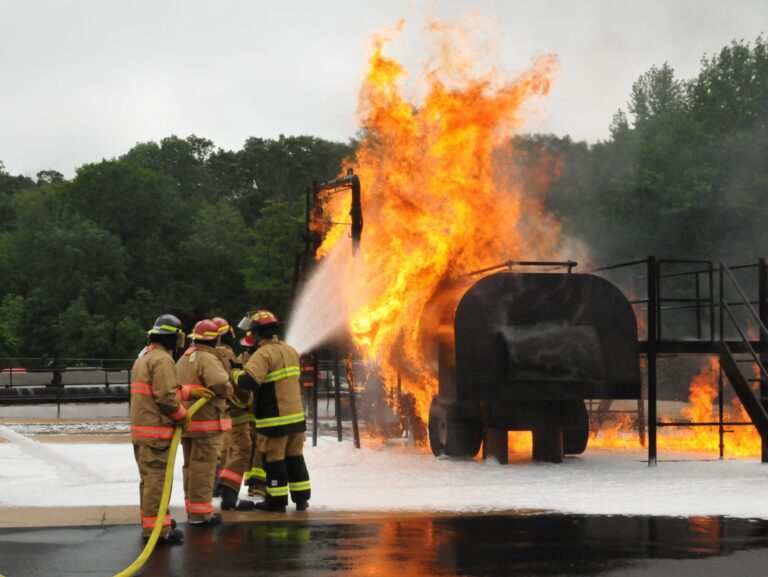
Once skills are mastered in the classroom, fire-fighters move outdoors for hands-on training. They test their skills in simulated fires that gradually introduce new elements and challenges, starting with smoke and heat and eventually progressing to a full fire and fuel spill scenario. They utilise their newly learned knowledge of the aircraft, fighting fires with limited visibility and intense heat, while also learning to work together as a team. These drills help build motor skills so when a real crisis strikes, fire-fighters use this muscle memory to respond more instinctively and less impulsively.
The FTRC at DFW International Airport is committed to providing this life-saving training to airports and fire-fighters around the globe. Instructors, who are certified fire-fighters, recognise that in today’s world, lives can be saved when disaster strikes aboard an aircraft. As the International Air Transport Association recently reported, of the 3.1 billion airline passengers aboard commercial flights in 2013, 210 of those passengers died. More often than not, the first responders to an emergency incident or accident involving an aeroplane are aircraft rescue fire-fighters (ARFF). Training to ensure these fire-fighters are ready, properly educated, fully experienced and able to react quickly can make all the difference in saving lives and minimising damage.
DFW opened its Fire Training Centre in 1994 on airport property in order to train certified fire-fighters to become aircraft rescue fire-fighters. Soon, local airport fire-fighters from surrounding communities and from around the country began participating. Last year, the Centre reopened after a year- long upgrade and revitalisation program as the Fire Training Research Centre. The Centre underwent a massive renovation and retooling thanks to a $19 million grant from the Federal Aviation Administration to bolster improvements in the classroom, on the training field and for the exchange of best practices for aircraft fire-fighters from around the world. Over its 20 year history, more than 19,000 fire-fighters from more than 40 US states and 35 countries have trained at DFW Airport’s Fire Training Research Centre.