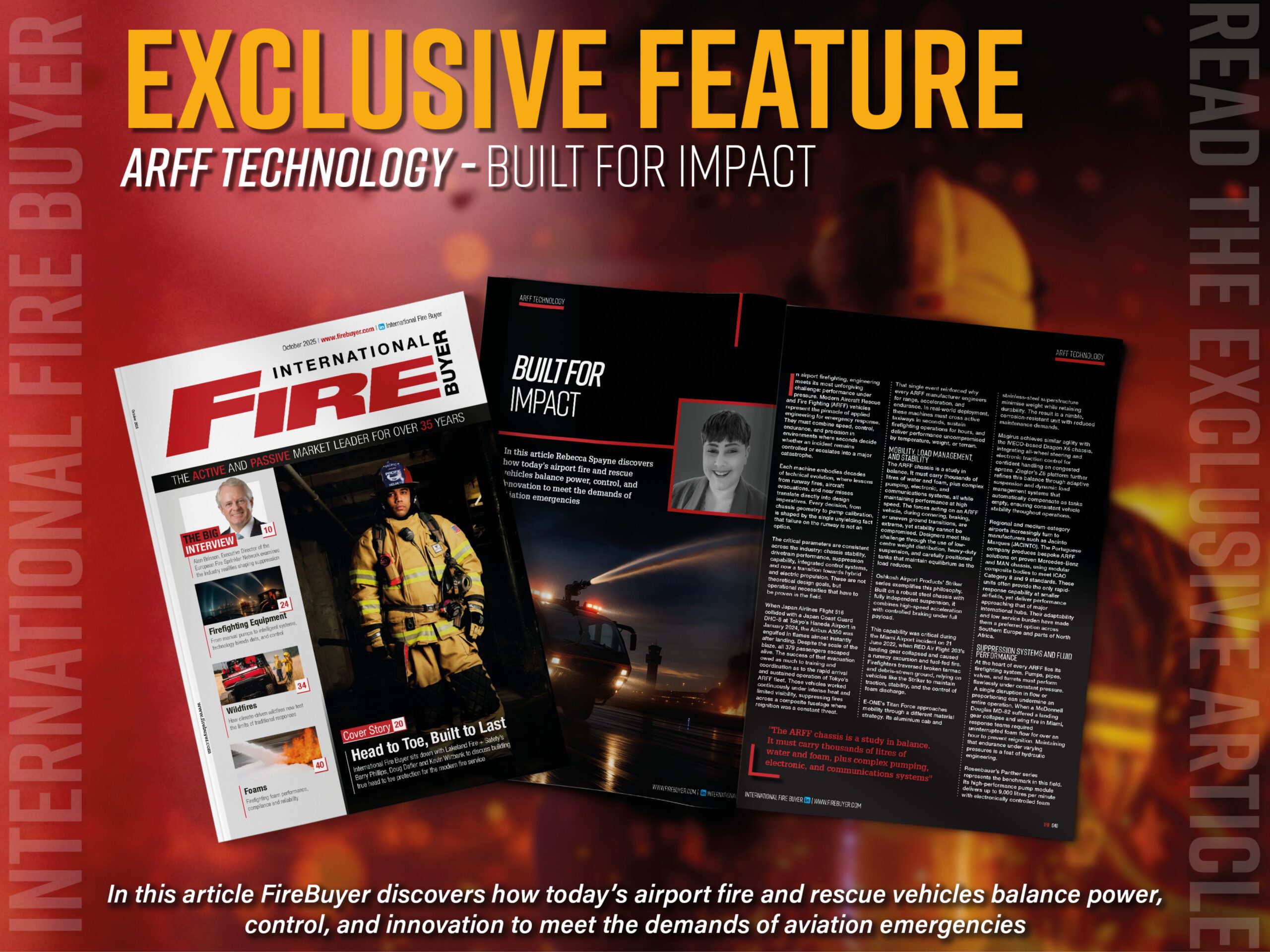

In this article Rebecca Spayne discovers how today’s airport fire and rescue vehicles balance power, control, and innovation to meet the demands of aviation emergencies.
In airport firefighting, engineering meets its most unforgiving challenge: performance under pressure. Modern Aircraft Rescue and Fire Fighting (ARFF) vehicles represent the pinnacle of applied engineering for emergency response. They must combine speed, control, endurance, and precision in environments where seconds decide whether an incident remains controlled or escalates into a major catastrophe.
Each machine embodies decades of technical evolution, where lessons from runway fires, aircraft evacuations, and near misses translate directly into design imperatives. Every decision, from chassis geometry to pump calibration, is shaped by the single unyielding fact that failure on the runway is not an option.
The critical parameters are consistent across the industry: chassis stability, drivetrain performance, suppression capability, integrated control systems, and now a transition towards hybrid and electric propulsion. These are not theoretical design goals, but operational necessities that have to be proven in the field.
When Japan Airlines Flight 516 collided with a Japan Coast Guard DHC-8 at Tokyo’s Haneda Airport in January 2024, the Airbus A350 was engulfed in flames almost instantly after landing. Despite the scale of the blaze, all 379 passengers escaped alive. The success of that evacuation owed as much to training and coordination as to the rapid arrival and sustained operation of Tokyo’s ARFF fleet. Those vehicles worked continuously under intense heat and limited visibility, suppressing fires across a composite fuselage where reignition was a constant threat.
That single event reinforced why every ARFF manufacturer engineers for range, acceleration, and endurance. In real-world deployment, these machines must cross active taxiways in seconds, sustain firefighting operations for hours, and deliver performance uncompromised by temperature, weight, or terrain.
Mobility, Load Management, and Stability
The ARFF chassis is a study in balance. It must carry thousands of litres of water and foam, plus complex pumping, electronic, and communications systems, all while maintaining performance at high speed. The forces acting on an ARFF vehicle, during cornering, braking, or uneven ground transitions, are extreme, yet stability cannot be compromised. Designers meet this challenge through the use of low-centre weight distribution, heavy-duty suspension, and carefully positioned tanks that maintain equilibrium as the load reduces.
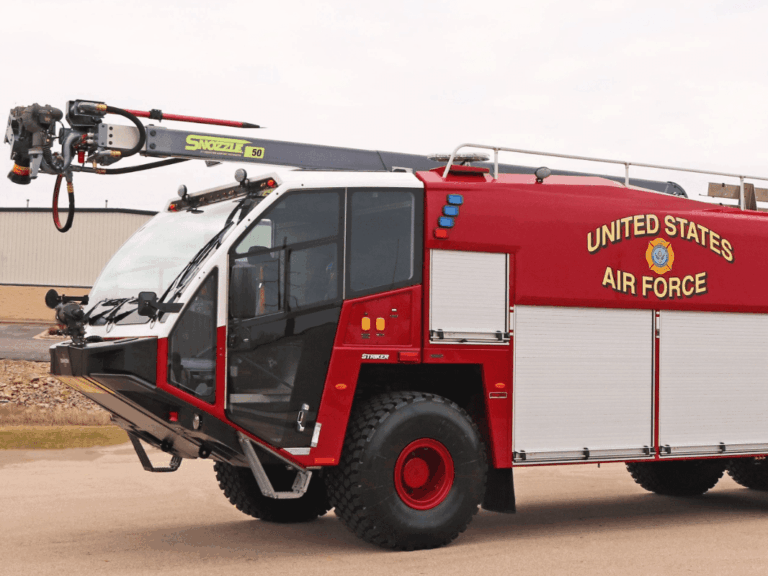
Oshkosh Airport Products’ Striker series exemplifies this philosophy. Built on a robust steel chassis with fully independent suspension, it combines high-speed acceleration with controlled braking under full payload.
This capability was critical during the Miami Airport incident on 21 June 2022, when RED Air Flight 203’s landing gear collapsed and caused a runway excursion and fuel-fed fire. Firefighters traversed broken tarmac and debris-strewn ground, relying on vehicles like the Striker to maintain traction, stability, and the control of foam discharge.
E-ONE’s Titan Force approaches mobility through a different material strategy. Its aluminium cab and stainless-steel superstructure minimise weight while retaining durability. The result is a nimble, corrosion-resistant unit with reduced maintenance demands.
Magirus achieves similar agility with the IVECO-based Dragon X6 chassis, integrating all-wheel steering and electronic traction control for confident handling on congested aprons. Ziegler’s Z6 platform further refines this balance through adaptive suspension and dynamic load management systems that automatically compensate as tanks empty, ensuring consistent vehicle stability throughout operations.
Regional and medium-category airports increasingly turn to manufacturers such as Jacinto Marques (JACINTO). The Portuguese company produces bespoke ARFF solutions on proven Mercedes-Benz and MAN chassis, using modular composite bodies to meet ICAO Category 8 and 9 standards. These units often provide the only rapid-response capability at smaller airfields, yet deliver performance approaching that of major international hubs. Their adaptability and low service burden have made them a preferred option across Southern Europe and parts of North Africa.