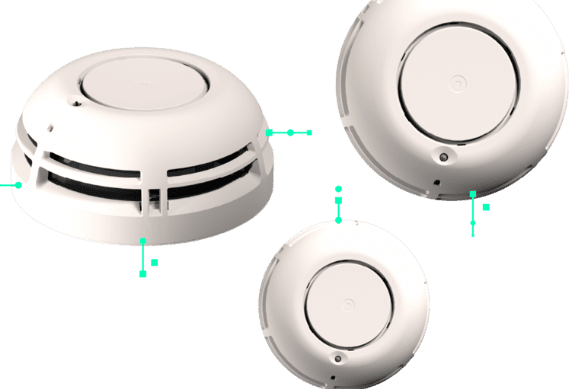

Siemens Smart Infrastructure has unveiled its Sinteso Nova and Cerberus Nova fire detector portfolio, designed to transform fire safety into a proactive, connected system supporting the development of autonomous buildings.
IoT connectivity and predictive maintenance capabilities
The new detectors are fully IoT enabled, offering 24/7 self checks, real time monitoring, remote diagnostics and predictive maintenance through cloud connectivity.
Integration with Siemens Building X Fire Apps provides shared data insights for facility teams and service providers.
Key technologies include Disturbance Free Testing, which enables continuous automated system checks, and Smoke Entry Supervision, which monitors smoke entry points in real time.
ASAplus technology, combining multi wavelength optical and dual thermal detection, reduces false alarms and minimises unnecessary evacuations.
In healthcare environments, the systems support continuous autonomous detection while reducing downtime.
In data centres, where overheating and electrical faults present risks, the detectors provide condition transparency and enable rapid, proactive response.
For higher education and commercial real estate, the portfolio enables centralised monitoring across multiple sites, supporting consistent protection standards and reducing operational disruption.
Industry perspective on autonomous building safety
The systems support stepwise upgrades with existing fire panels, enabling plug and play integration without full replacement.
Manufactured in Switzerland, the detectors carry Siemens EcoTech labelling, incorporating recycled plastics and supporting circular economy principles.
Peter Nebiker, Head of Fire Safety at Siemens Smart Infrastructure Buildings, said: “The launch of our Sinteso Nova and Cerberus Nova fire detection portfolio is a game-changer in ensuring all alarms are accurate as best as possible.
“By moving from periodic checks to continuous, data-driven, self-supervising systems, we’re laying the foundation for truly human-centric, autonomous buildings.
“By automating testing, delivering real-time insights, and enabling remote action, these solutions protect people while freeing up staff to focus on strategic priorities.
“This shift isn’t just about innovation – it’s about smarter, safer, and more efficient operations.”